Treasury’s Short-Term Funding Trap
How a 38.2-basis-point increase in bill rates can erase the annual savings from a full 100-basis-point decline in long-term rates—and why Treasury’s maturity choices put the Federal Reserve in a bind.
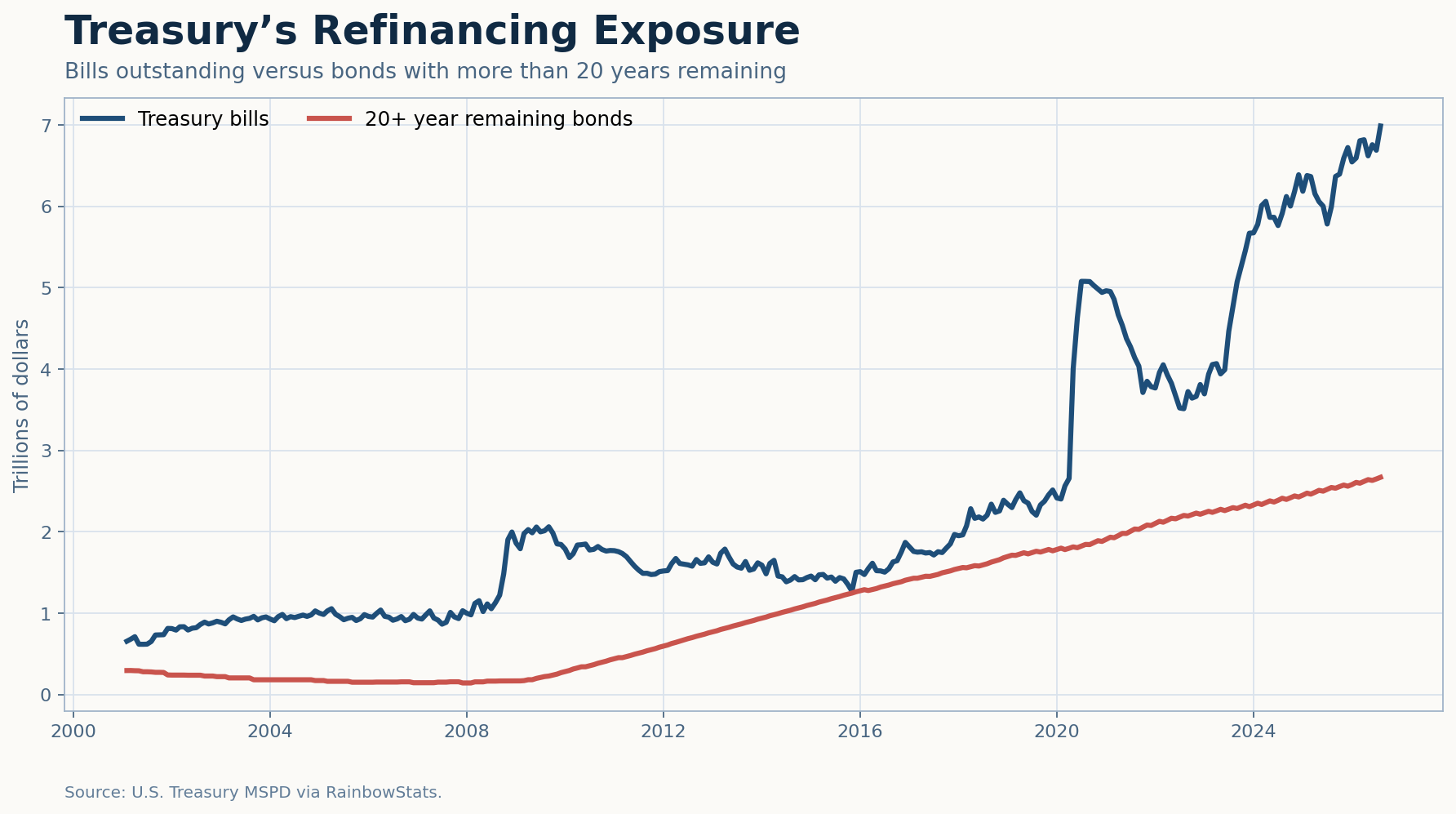
Treasury has made the federal balance sheet unusually sensitive to short-term interest rates. The latest Monthly Statement of the Public Debt shows $6.988 trillion of Treasury bills outstanding, compared with only $2.671 trillion of bonds with more than 20 years remaining.
This is not merely a question of whether the yield curve is steep or inverted. It is a question of how much debt must be refinanced at each point on that curve. Treasury has placed far more principal at the short end, where changes in interest rates reach the budget quickly.
The arithmetic is unforgiving
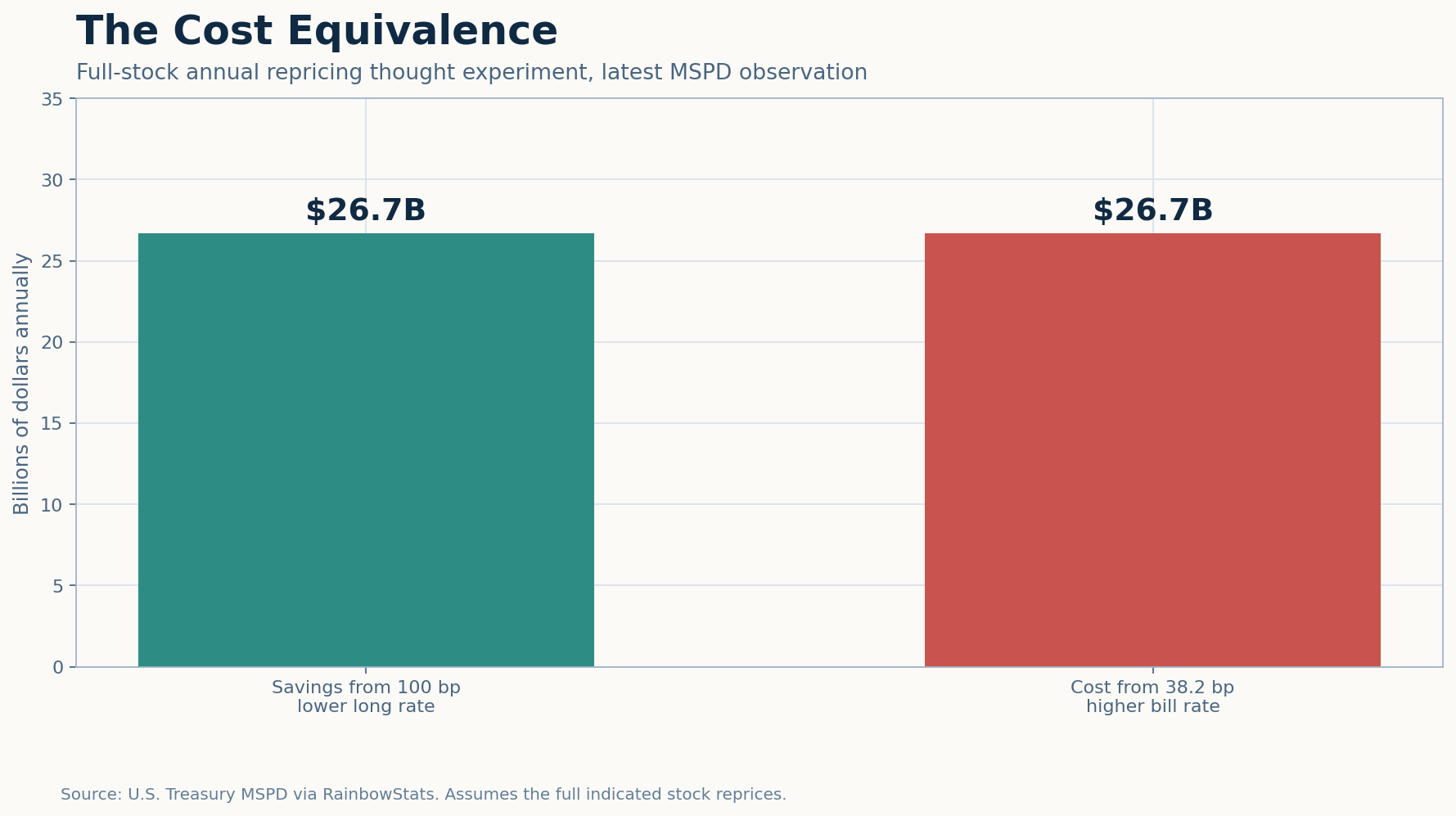
Suppose long-term Treasury rates fall by 100 basis points. If the entire stock of bonds with more than 20 years remaining could immediately refinance at that lower rate, the annual interest saving would be approximately $26.7 billion.
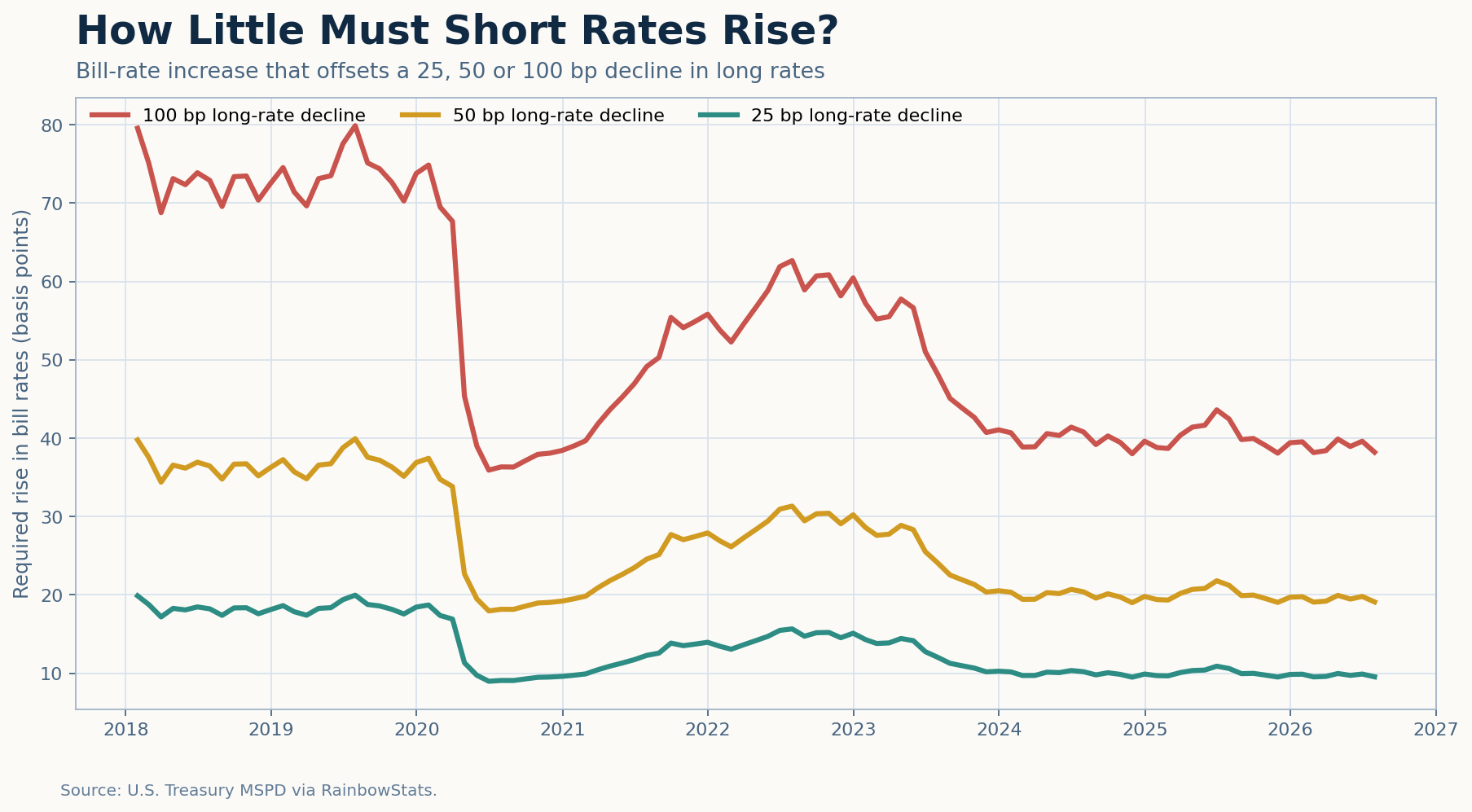
But a rise of only 38.2 basis points on $6.988 trillion of bills creates the same $26.7 billion annual cost.
Why this is balance-sheet mismanagement
Debt managers cannot control the level of interest rates, but they do control the maturity structure that determines how rapidly those rates reach taxpayers. Since December 2023, bills outstanding have increased by approximately $1.313 trillion, or 23.1%. Over the same period, the stock of bonds with more than 20 years remaining increased by about $0.340 trillion, or 14.6%.
That choice may reduce today’s term premium or accommodate near-term financing needs, but it leaves the government refinancing an enormous block of debt every few weeks or months. The result is a public balance sheet whose interest expense is increasingly tied to the Federal Reserve’s overnight policy rate.
The phrase balance-sheet mismanagement is therefore not a claim that the United States cannot pay its debts. It is a claim about risk concentration. Treasury has accepted a large, fast-resetting liability while hoping that lower long-term yields will deliver savings on a much smaller, slow-resetting stock.
The bind for the Federal Reserve
If inflation requires restrictive monetary policy, the Fed must keep short rates high enough to restrain credit and demand. Yet every month that short rates remain high rapidly increases Treasury’s refinancing cost. The maturity structure therefore creates political and fiscal pressure for earlier rate cuts.
The Fed still has legal authority to set policy in pursuit of its mandate. But Treasury’s funding choices make the cost of exercising that authority more visible and more immediate. The danger is not a formal loss of independence; it is a practical environment in which monetary restraint is blamed for fiscal costs that were amplified by Treasury’s own maturity decisions.
A warning from 1919
Milton Friedman and Anna Jacobson Schwartz described an earlier episode in which the Federal Reserve understood that its administered rate was below the market, recognized the monetary consequences, but hesitated to act:
“The Reserve Board was aware that Bank discount rates were below current market rates throughout 1919, that this was contributing to monetary expansion, and that monetary expansion was contributing to the inflation. ‘In April, 1919, the Board gave serious consideration to the suggestions made by several of the Federal Reserve Banks that the discount rate be advanced,’ yet it restricted itself to moral suasion, urging banks to discriminate between ‘essential and non-essential credits’—a formula that successive use from that time to this has rendered neither less appealing to the Reserve System as a means of shifting responsibility nor more effective as a means of controlling monetary expansion. And, of course, the Board also took the position that the expansion in the stock of money was a result, not a cause, of rising…” Milton Friedman and Anna Jacobson Schwartz, A Monetary History of the United States, 1867–1960, discussion of Federal Reserve policy in 1919. Ellipsis marks where the supplied excerpt ends.
The parallel is institutional, not mechanical. Today’s operating framework, banking system and fiscal structure are different. The enduring lesson is that a central bank can recognize inflationary pressure and still delay necessary tightening when other institutions make restraint politically uncomfortable.
The timing makes the exposure worse
Important qualification: the 38.2-basis-point calculation assumes that all 20+ year bonds immediately refinance at a rate 100 basis points lower. They do not. Bills, however, roll over rapidly. Therefore the long-rate savings arrive more slowly than the bill-rate costs. In the first year, an increase of less than 38.2 basis points could erase the savings actually realized from lower long rates.
This calculation is not a complete forecast of federal interest expense. It deliberately isolates bills and bonds with more than 20 years remaining. Notes, floating-rate notes, TIPS, maturities, issuance schedules and changes in the debt stock also matter. But the simplified comparison reveals the direction and scale of the risk with unusual clarity.
Bottom line
Treasury cannot count on a rally at the long end to rescue federal interest expense while leaving a massive bill portfolio exposed to short rates. The stock of bills is so large that a modest increase in short-term rates can overwhelm a much larger decline in long-term rates.
The Treasury has shortened the government’s effective refinancing horizon and made the budget more sensitive to the Fed. That does not force the Federal Reserve to cut. It does ensure that maintaining an appropriately restrictive policy will carry a larger and more politically conspicuous fiscal price.