History, finance and democratic legitimacy
Two Historical Echoes
The Great Financial Crisis, Europe’s lost growth, America’s inequality—and the return of fascist politics
In an earlier essay, I used Barbara Tuchman’s The Proud Tower and the example of Speaker Thomas B. Reed to warn about American imperial ambition. In another, I considered the economic and political aftermath of the crash of 1929. Those were two different historical warnings. Today they are beginning to sound together.
Tuchman’s subject was the world before the First World War—not the 1930s. The Proud Tower: A Portrait of the World Before the War, 1890–1914 describes a civilization that was wealthy, cultured, self-confident and largely unable to imagine the scale of the disaster toward which it was moving. Its governments pursued national prestige, colonies and military advantage while the institutions intended to restrain conflict remained too weak for the burden placed upon them.
Thomas B. Reed gave my earlier essay its moral center. Reed was no political outsider. He was a powerful Republican Speaker of the House, yet he resisted the war with Spain and the larger movement toward American empire. The House historian describes him as fiercely opposed to the conflict and generally resistant to American imperial ambition. He also opposed the annexation of Hawaii. Reed understood that a republic could betray its principles while persuading itself that it was merely demonstrating strength.
A proud tower is most dangerous when the people inside it mistake confidence for security and power for wisdom.
The second echo: from economic collapse to political collapse
The second warning begins in 1929. The stock-market crash did not mechanically cause the Second World War, and it would be careless to suggest that it did. But the Depression helped destroy confidence in democratic government, intensified national grievance, encouraged protectionism and isolation, and weakened the capacity for collective action. War began in Asia in 1937 and in Europe in 1939.
The United States Department of State’s historical account draws the connection carefully. Governments turned inward, the London Economic Conference failed to produce effective cooperation, and militaristic regimes promised both economic relief and national expansion. The postwar architects of Bretton Woods and the General Agreement on Tariffs and Trade later concluded that the discriminatory trading blocs, tariffs and competitive devaluations of the 1930s had destabilized the international environment without solving the underlying economic problem.
The lesson was not that economics is literally everything. It was that prolonged economic failure changes what citizens will tolerate politically. When democratic institutions no longer appear capable of delivering security, dignity and progress, movements built on grievance acquire an audience.
The crisis that did not end
The conventional chronology says the Great Financial Crisis began in 2007–08 and ended when economic growth resumed. The charts suggest a different chronology. The acute panic ended, but its balance-sheet and political consequences continued for years.
The United States responded brutally but comparatively quickly. Banks recognized loan losses, charge-offs surged, federal authorities conducted stress tests, and institutions raised capital. Ben Bernanke was heavily criticized for rescuing the financial system. Much of that criticism was understandable: millions of households experienced foreclosure and unemployment while large financial institutions survived with public assistance. Yet allowing the banking system to collapse would not have punished only bankers. It would have destroyed the mechanism through which households and firms obtain credit.
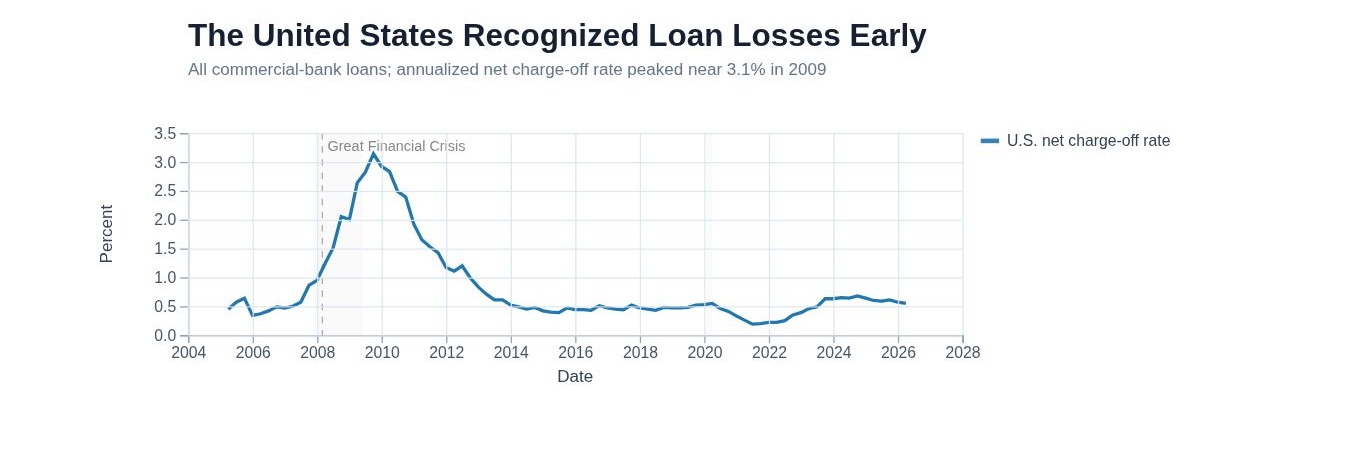
The 2009 stress tests mattered because they made prospective capital needs visible. The Federal Reserve describes the tests as helping restore investor confidence and enabling banks to raise capital. That did not make the rescue fair in every respect. It made the banking system capable of lending again.
Europe followed a slower and more complicated route. Its crisis became entangled with sovereign debt, national banking systems, a shared currency and fragmented fiscal authority. The ECB’s harmonized supervisory series begins only in 2015, so it cannot display the original 2008 loss event. What it does reveal is striking: significant euro-area banks still reported a non-performing-loan ratio of roughly 7.5 percent in 2015.
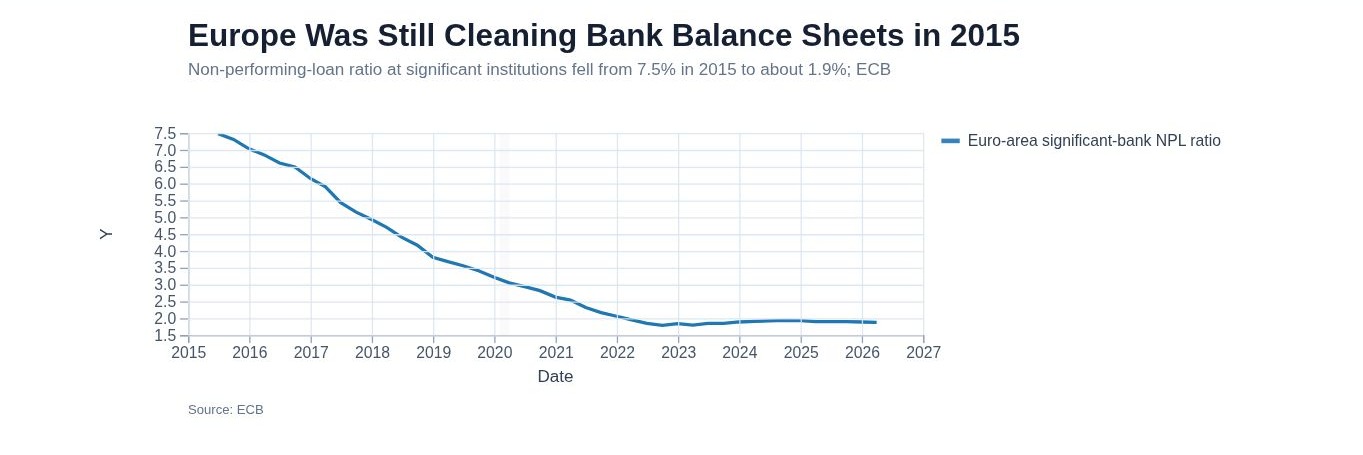
In 2014, the ECB itself distinguished between two forms of deleveraging. In the “good” version, banks rapidly remove impaired assets and raise equity so that lending can restart. In the “bad” version, they retain non-performing assets and shrink sound lending, creating zombie banks and prolonged weak credit growth. This is remarkably close to the story told by the data.
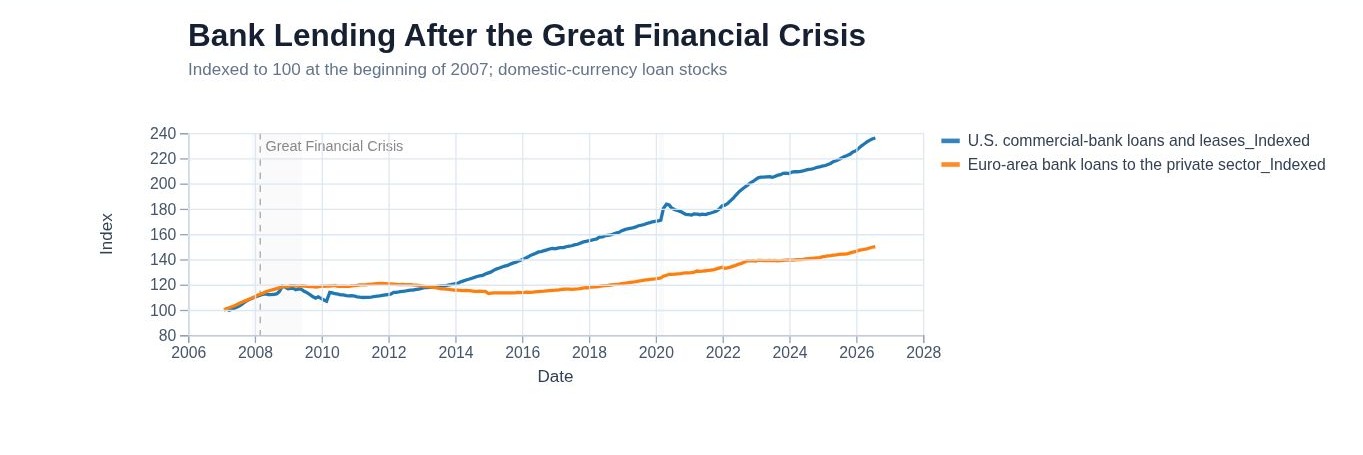
By early 2015, the U.S. loan index was around 130 while the euro-area index was only about 113. In the latest observations in this study, the respective levels are approximately 236 and 150. These series are not perfectly identical institutional measures, so the exact gap should not be treated as an accounting identity. The persistent divergence is nevertheless too large to dismiss.
From bank balance sheets to national income
Credit is not the whole economy, but a banking system occupied with old losses is less able to finance new firms, productive investment and household demand. The next charts examine gross national income per person in the United States and the eurozone.
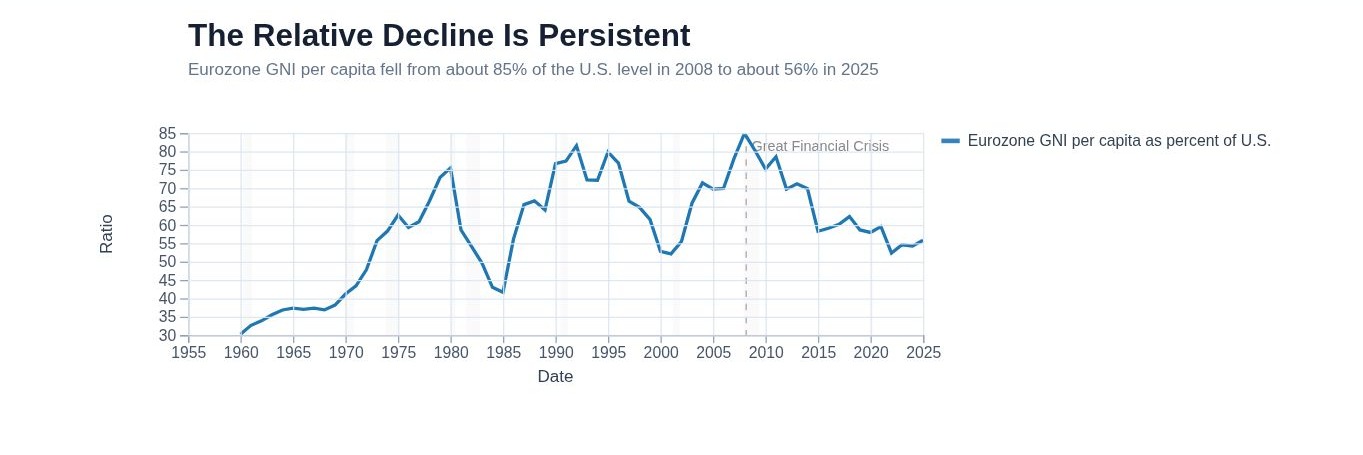
The dollar comparison is intentionally direct, but it requires care. A weaker euro lowers eurozone income when translated into dollars even if domestic purchasing power is unchanged. Different price levels, tax systems and public services also matter. A purchasing-power or real-income comparison would answer a somewhat different question. Even with those qualifications, the post-crisis change in the transatlantic relationship deserves attention.
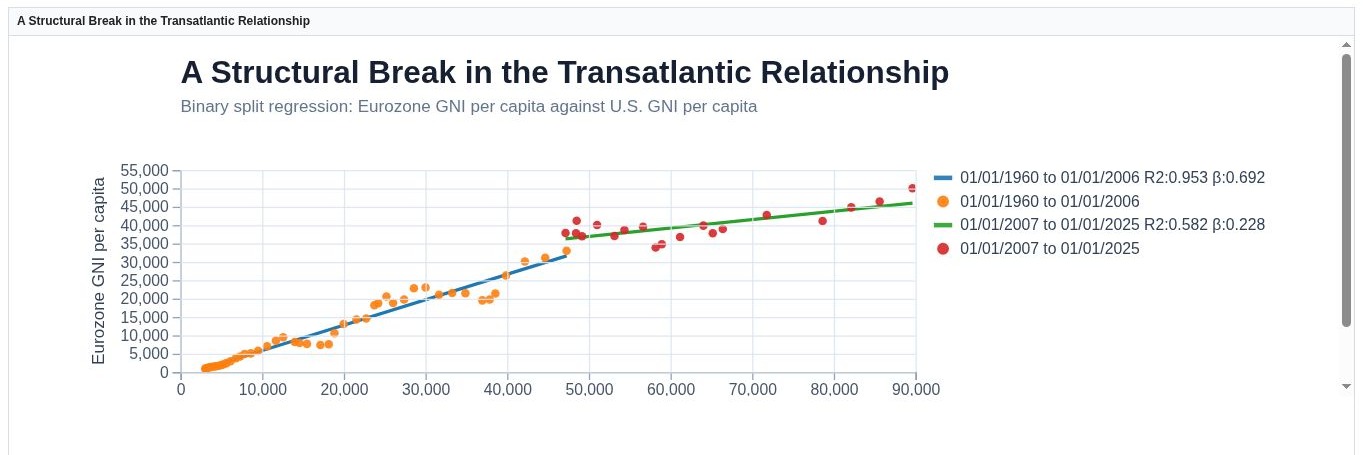
The regression is the most provocative figure in the study, and therefore the one we must describe most cautiously. It does not prove that delayed European bank repair caused the entire income divergence. Productivity, demographics, energy costs, fiscal policy, industrial composition and exchange rates also matter. What the full sequence establishes is a plausible mechanism: delayed loss recognition coincided with weak credit creation, and weak credit creation accompanied a lasting deterioration in relative national income.
Europe received stagnation; America received inequality
The two sides of the Atlantic did not suffer the same post-crisis wound. Europe endured a longer period of balance-sheet repair, austerity and weak lending. The United States restored credit sooner, but the rescue left a deep perception that government could mobilize enormous resources for banks while ordinary citizens absorbed foreclosures, lost employment and diminished security.
That perception found support in a highly unequal distribution of income and wealth. The Congressional Budget Office reports that income grew most rapidly for households at the top of the distribution over the long period through 2019. It also estimates that the wealthiest 10 percent of families held 60 percent of family wealth in 2022. A financial rescue can be economically necessary and still leave a politically dangerous question unanswered: necessary for whom?
This gives us two routes from financial crisis to political reaction:
Europe: delayed repair → constrained lending → weak investment and income growth → declining confidence in established parties.
United States: rapid financial stabilization → unequal recovery and perceived impunity → declining confidence that institutions serve ordinary citizens.
Neither route predetermines a fascist outcome. Migration, race, national identity, social media, war and political leadership all shape the form that discontent takes. But economic insecurity enlarges the population willing to reject the existing order. Research covering more than 800 elections in 20 advanced economies finds that far-right parties are the principal political beneficiaries of systemic financial crises, with their vote share increasing by roughly one-third on average during the five years after a crisis. Normal recessions do not produce the same pattern.
When “populism” becomes too gentle a word
Germany’s Alternative für Deutschland won 20.8 percent of the second vote and 152 Bundestag seats in the 2025 federal election—more than double its 2021 share. Economic frustration does not explain every AfD vote, and not every person who votes for the party is a fascist. But that qualification must not become an excuse for euphemism.
A Nazi salute is fascism. The intentional revival of Nazi slogans and symbols is fascist conduct. AfD leader Björn Höcke was convicted of knowingly using a banned SA slogan. Another AfD parliamentarian has been charged—though not convicted—with performing a Nazi salute inside the Reichstag. When a political movement repeatedly tolerates such conduct among prominent figures, “populism” no longer captures the whole phenomenon.
The economic explanation is not an exoneration. Hardship can help explain why an electorate becomes receptive to authoritarian politics. It does not excuse the politicians who employ fascist symbols, nor the voters who knowingly accept them.
The institutions are the battleground
Here the two historical echoes meet. Before 1914, imperial competition outran the institutions meant to restrain it. During the 1930s, economic nationalism and domestic crisis weakened international cooperation precisely when collective action was most necessary. After 1945, the United States and its allies built institutions on the assumption that prosperity and peace were connected.
Those institutions are imperfect. The European Union, NATO, the World Trade Organization, international courts and central-bank cooperation all deserve criticism and reform. But destroying an institution is easier than rebuilding the trust that made it possible. A retreat into tariffs, spheres of influence, territorial ambition and national grievance would not restore democratic control. It would reproduce the conditions that earlier generations learned—at an appalling cost—to fear.
Thomas Reed’s example belongs here. He opposed imperialism not because the United States was weak, but because he believed a strong republic must remain faithful to its principles. His resistance asked a question that remains urgent: what is national power for?
A warning is not a prophecy
The analogy has limits. Today’s democracies possess deposit insurance, welfare states, active central banks and institutions that did not exist—or existed only weakly—in the interwar world. Europe is not Weimar Germany. The AfD is not the whole German nation. The United States has not abandoned every postwar commitment.
But historical warnings are useful precisely before the analogy becomes complete.
The Great Financial Crisis did not end when GDP recovered. In Europe, it migrated from bank balance sheets into weak credit and national income. In the United States, it migrated into inequality and distrust. In both places, the unresolved injury eventually reached the ballot box.
Bernanke was right to prevent the banking system from collapsing. Europe was too slow to recognize and remove impaired credit. But rescuing finance was only the first obligation. The unfinished task was to produce a recovery that citizens could recognize as fair, broadly shared and compatible with democratic dignity.
If international institutions are dismantled while fascist language is normalized, we should not comfort ourselves by insisting that the present is not identical to the past. Of course it is not identical. History does not repeat with statistical precision. It offers patterns, pressures and choices.
The proud tower remains standing—so far. That is what makes this a warning rather than an obituary.
Sources and replication
- RainbowStats: The Great Financial Crisis—One Shock, Two Repairs. Interactive FRED, ECB and World Bank analysis.
- History Gives Us a Warning on U.S. Imperialism. The companion Thomas B. Reed essay.
- Library of America: The Proud Tower.
- U.S. House of Representatives: Thomas B. Reed and the Spanish-American War.
- U.S. Department of State: The Great Depression and U.S. Foreign Policy.
- U.S. Department of State: the interwar lessons behind Bretton Woods and GATT.
- Federal Reserve: the policy response and 2009 bank stress tests.
- European Central Bank: good and bad forms of bank deleveraging.
- Funke, Schularick and Trebesch: “Going to Extremes—Politics after Financial Crises, 1870–2014”.
- Congressional Budget Office: Trends in the Distribution of Family Wealth, 1989–2022.
- Federal Returning Officer: final results of Germany’s 2025 Bundestag election.
- Associated Press: Björn Höcke’s conviction for using a Nazi slogan.
- Reuters: charge involving an alleged Nazi salute in the Reichstag.
Method note. The charts describe associations and timing. The split regression selects the break that best separates the two fitted relationships; it should be interpreted as exploratory evidence, not a causal design. Current-dollar international comparisons are sensitive to exchange rates.