Technology, work and the human person
Fifty Years Later: The Human Toll of a Technological Society
Kenneth Keniston asked what modern society was doing to the inner lives of young Americans. In the age of artificial intelligence, the question feels less dated than unfinished.
The complete script, data retrieval, county cross-section and slideshow can be opened and rerun.
Run the RainbowStats analysis
Nearly fifty years ago, in 1977, I read Kenneth Keniston’s The Uncommitted: Alienated Youth in American Society for a graduate course on planned economies taught by a visiting professor from Yugoslavia. Perhaps that setting explains why, over time, I came to associate the book with Marx: Marx supplied the language of alienation, while Keniston examined its human consequences in modern America. I never forgot the book’s description as a study of the “human toll of our technological society.” Now, amid confident predictions that artificial intelligence will bring greater productivity and abundance, I find myself returning to Keniston’s question: What will this new technological society ask of the people who must live within it?
So we decided to take a look.

Keniston was not writing about computers replacing office workers. His subjects were a small group of talented, privileged young men who rejected the dominant values and institutions of American society. His method was psychological, but his argument moved outward. Alienation could not be understood solely as a defect inside an individual. We also had to ask what kind of society the person was becoming alienated from.
He drew attention to chronic social change, weakened community, the separation of work from family and the mounting demand for performance. Those themes sound strikingly contemporary. Our machines are different, but the pressure to adapt ourselves to systems organized around speed, measurement and output is familiar.
This does not mean that every unhappy person is “alienated” in Keniston's precise sense. Nor does a county mental-health statistic reproduce his intensive study of individual lives. The value of returning to the book is not that it supplies a ready-made diagnosis. It supplies a durable question.
Productivity is not the same thing as progress
The most familiar promise of technology is higher productivity: more output from each hour of work. That promise has been substantially fulfilled. The first chart compares labor productivity with real hourly compensation in the nonfarm business sector. Both are official Bureau of Labor Statistics indexes, placed at 100 in 1973 so that their subsequent paths can be compared.
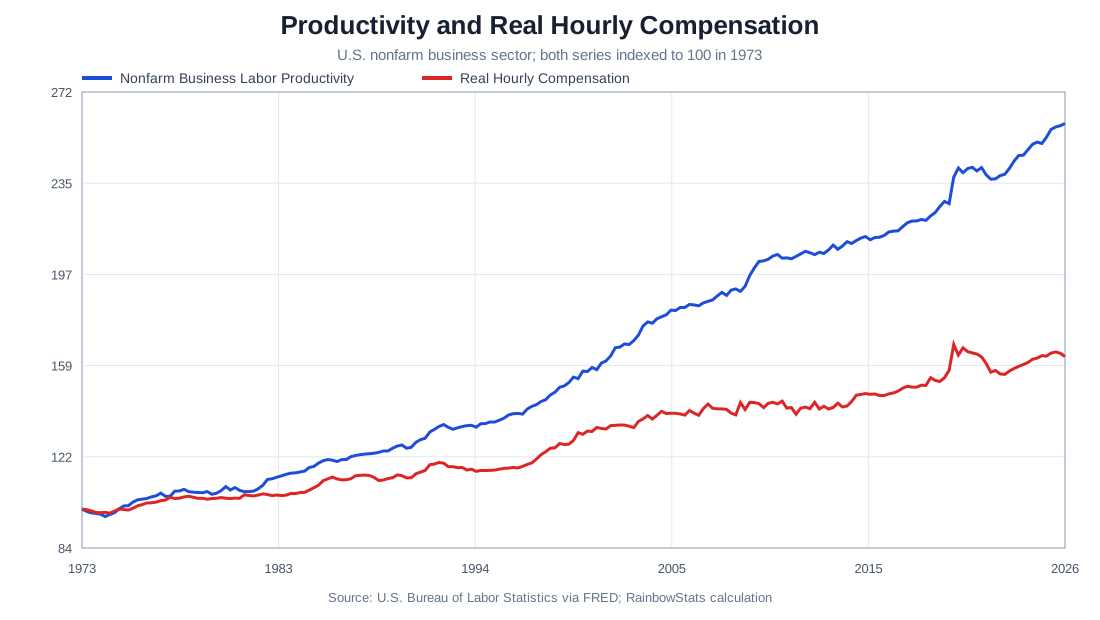
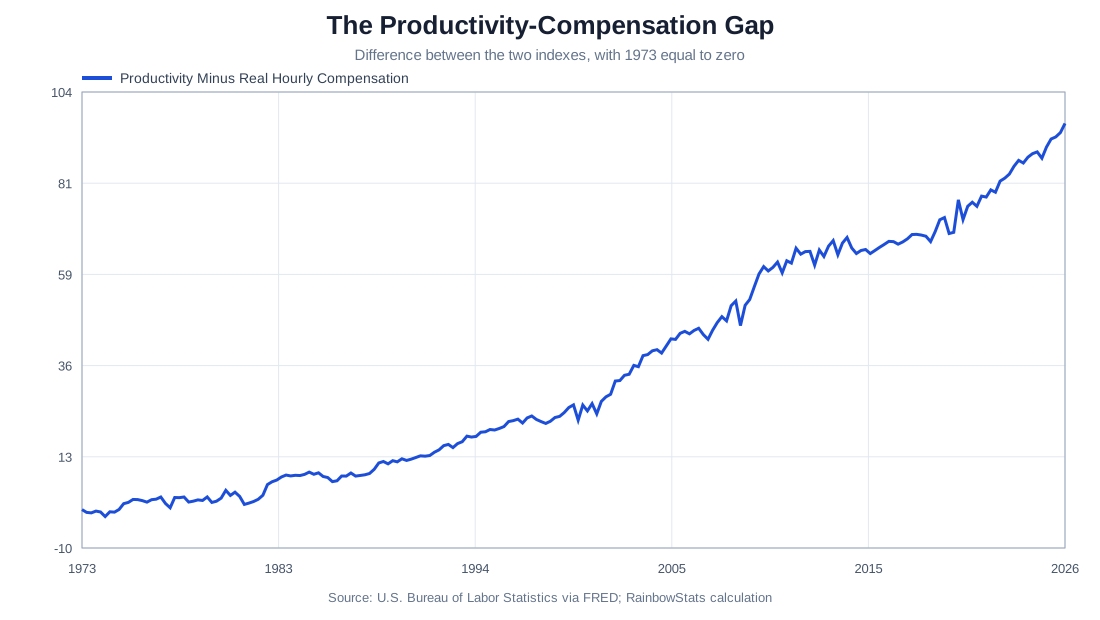
By the latest observation in the replicated dataset, the productivity index has reached roughly 259 while the real-compensation index is about 163. That comparison must be handled carefully. Compensation includes more than a paycheck; deflators, benefits, workforce composition and the choice of starting date matter. The graph is not a one-picture proof of exploitation, and it certainly is not a direct measure of alienation.
But it establishes an important tension. An economy can become vastly more capable without distributing its measured gains proportionately through real hourly compensation. Productive power and lived progress are related, but they are not identical.
A new technological warning
Pope Leo XIV takes up this tension directly in his 2026 encyclical Magnifica Humanitas, written on safeguarding the human person in the time of artificial intelligence. His discussion of work is unusually concrete. Work is not merely a cost of production or a source of income; it is also a setting in which people develop capabilities, form relationships, exercise responsibility and contribute to a community.
Leo does not reject artificial intelligence. He recognizes its capacity to relieve arduous, repetitive and dangerous labor. His warning concerns the direction of adaptation. AI may promise productivity while requiring workers to conform to the pace and demands of machines. Systems can de-skill work, intensify surveillance and weaken the agency that technology was supposed to enlarge.
“The human person is an end, not a means.” Pope Leo XIV, Magnifica Humanitas, section 152
That principle gives the productivity chart a different meaning. The central question is no longer simply whether a technology raises output. It is whether greater output serves participation, dignity and a genuinely human life. An economy can score well on production and still impose losses that its production statistics do not record.
Moving from the national economy to counties
Those reflections led us to a deliberately modest empirical exercise. If the human costs of modern life do not appear fully in productivity or compensation, can we detect anything at the local level?
Using RainbowStats, we assembled a 2022 cross-section covering all 39 Washington counties and all 99 Iowa counties. The outcome is the age-adjusted prevalence of frequent mental distress among adults. The explanatory variables are social isolation, food insecurity and county median household income relative to the national median.
The pooled relationship
The answer is suggestive. Social isolation and food insecurity are both positively associated with frequent mental distress, even after each is considered alongside the other variables. Relative county income, by contrast, contributes almost nothing to the pooled regression once isolation and food insecurity are included.
| Variable | Coefficient | Standard error | t-statistic |
|---|---|---|---|
| Constant | 2.787 | 2.976 | 0.937 |
| Social isolation | 0.320 | 0.086 | 3.733 |
| Food insecurity | 0.214 | 0.058 | 3.691 |
| Median income relative to U.S. | −0.001 | 0.009 | −0.062 |

The geography left in the residuals
The residuals are where this exercise becomes most interesting. A residual is simply the difference between actual mental distress and the value predicted from isolation, food insecurity and relative income. Positive residuals mean distress is higher than the model predicts; negative residuals mean it is lower.
When the counties are ordered by their residuals and colored by state, the errors do not look geographically random. Several Washington counties occupy the positive tail, while several Iowa counties occupy the negative tail. Among the ten largest absolute residuals, seven are Washington counties with positive residuals; the three Iowa counties have negative residuals.

This complicates the story in a useful way. Adding Iowa causes the explanatory power of the model to fall sharply from the much stronger Washington-only result. Similar measured levels of isolation, food insecurity and income do not imply identical reported distress in both states.
It is tempting to explain the difference immediately. Washington's migration patterns, housing costs and visible homelessness come to mind. Yet the largest Washington residuals are not confined to Seattle or the Interstate 5 corridor. Lincoln, Ferry, Cowlitz, Spokane, Asotin, Wahkiakum and Columbia counties appear among the largest positive residuals, while King County does not appear among the ten largest outliers. A simple “end of the road” account is therefore not enough.

The bell curve offers another caution. A pooled distribution may look broadly ordinary while concealing two regional patterns underneath it. The colored residual chart tells us something the histogram cannot: errors may be clustered by place. A more formal study would add state effects, test spatial dependence and introduce measures of age, migration, housing burden, health-care access and urban-rural composition.
What has persisted for fifty years?
Keniston's book and Pope Leo's encyclical come from different traditions and different moments. Keniston began with the interior lives of alienated young men and moved toward the social order. Leo begins with a moral account of the human person and applies it to the digital transformation. Neither can be reduced to a regression, and neither should be.
Yet they converge on an insight that economics sometimes forgets: human beings do not experience society only through aggregate output or average income. They experience it through agency, belonging, useful work, security, relationships and the sense that their lives participate in something intelligible.
Our county results are consistent with that broader concern, but they do not prove it. Food insecurity and isolation accompany mental distress. Income by itself does not make the relationship disappear. Geography remains powerful, reminding us that institutions and communities mediate the pressures people face.
The age of AI will generate extraordinary demonstrations of technical capability. Some will genuinely improve human life. But if the gains appear primarily in productivity statistics while work loses autonomy, communities weaken and individuals become more isolated, we may discover that technological success and human progress have again parted company.
Fifty years after reading Keniston, I find his question more useful than any prediction: What is the human toll of the society we are building?
Sources and replication
- Complete RainbowStats replication.
- Kenneth Keniston, The Uncommitted: Alienated Youth in American Society (1965).
- Pope Leo XIV, Magnifica Humanitas (2026), especially sections 148–159.
- U.S. Bureau of Labor Statistics, labor productivity and real hourly compensation, retrieved through FRED.
- CDC PLACES county measures: frequent mental distress, social isolation and food insecurity.
- County and national median household-income series retrieved through FRED.
All county results are exploratory and descriptive. Associations among aggregate county measures should not be interpreted as individual-level or causal effects.