A currency peg can suppress the visible movement of an exchange rate. It cannot eliminate the economic pressure behind it. During the 1990s, governments, banks and corporations repeatedly learned that distinction after capital inflows, domestic credit expansion and dollar borrowing created obligations that national institutions could no longer defend.
Mexico's peso crisis was the warning. The Asian crisis was the broader demonstration. Russia and Brazil then showed how a regional currency event could become a global funding event. This essay uses monthly exchange-rate data and Seemingly Unrelated Regression—SUR—to distinguish common global influences from the residual movement that remained inside the currencies themselves.
The warning from Mexico
Mexico entered 1994 with a managed exchange rate, a large current-account deficit, declining reserves and growing reliance on short-term securities linked to the dollar. Tesobonos moved exchange-rate risk away from foreign investors and onto the Mexican state. Political assassinations, the Chiapas uprising and rising U.S. interest rates accelerated the loss of confidence. When the exchange-rate regime broke in December, the peso adjustment increased the domestic burden of dollar obligations and destabilized banks and borrowers.
The rescue prevented a wider immediate collapse, but it encouraged an incomplete lesson. Mexico was treated as a country-specific policy failure. Investors soon returned to emerging markets, including East Asia, where apparently stronger fiscal positions concealed a different form of leverage.
What precipitated the Asian crisis?
The Asian crisis was not primarily a story of excessive sovereign debt. It was a story of private balance sheets operating beneath exchange rates that appeared safer than they were.
- Managed currencies reduced the perceived cost of dollar borrowing. Banks and corporations borrowed in dollars while earning revenue in baht, rupiah, won or ringgit.
- Short-term foreign funding financed long-lived domestic assets. Property, industrial capacity and infrastructure could not be liquidated quickly when foreign lenders refused to roll their claims.
- Credit growth weakened underwriting. Rising property and equity prices made collateral appear to validate the lending that had inflated it.
- Reported reserves overstated usable defenses. Forward commitments and the maturity of foreign obligations mattered as much as the headline reserve number.
- The system contained a feedback loop. Devaluation raised the local-currency value of dollar debt, damaging banks and companies and causing additional capital flight.
Thailand was the first break. A large external deficit, property losses and weakness among finance companies made the baht increasingly difficult to defend. The central bank spent reserves and used forward transactions to resist speculative pressure. On 2 July 1997 Thailand abandoned the defense and allowed the baht to float.
The float changed the market's question. Investors stopped asking whether Thailand was weak and began asking which apparently similar currency would be next.
From devaluation to regional liquidation
The mechanism was both financial and psychological. Once Thailand broke, lenders reconsidered the maturity structure, currency exposure and bank solvency of neighboring economies. Withdrawing a short-term credit line was individually rational. When many banks did it together, the attempt to reduce exposure created the very insolvency they feared.
How RainbowStats measures contagion
We estimate monthly currency equations for Mexico, Brazil, Thailand, Malaysia, South Korea, Indonesia, Russia and India. Currency changes are measured as logarithmic changes in local currency per U.S. dollar, so a positive number represents depreciation.
Each equation controls for the monthly change in the U.S. 10-year Treasury yield and the monthly change in WTI oil prices. These controls remove two obvious global influences. RainbowStats first combines the equations with SIMU_REGRESSION; SUR then estimates the system using the covariance of the equation residuals.
The residuals are the important object. If two currencies retain a high residual correlation after the common controls, they are sharing a disturbance the model has not attributed to U.S. rates or oil. The event-window comparison asks whether those relationships changed when the crisis began.
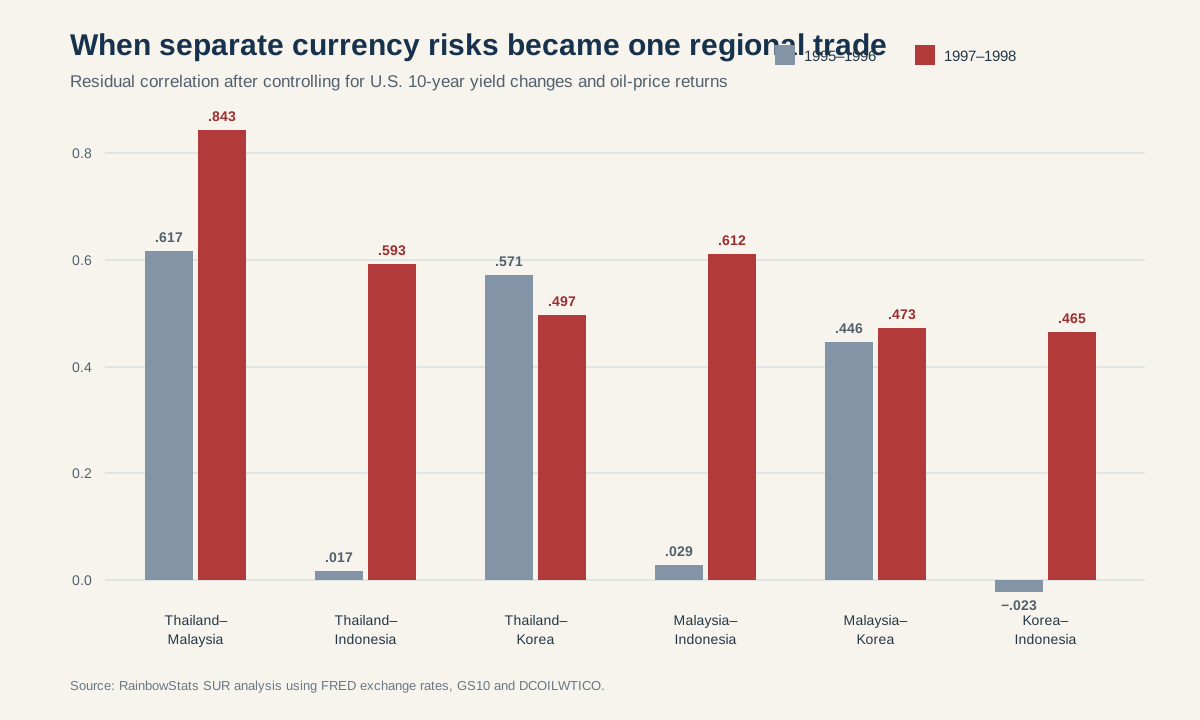
| Currency pair | 1995–1996 | 1997–1998 | Change |
|---|---|---|---|
| Thailand–Malaysia | 0.617 | 0.843 | +0.226 |
| Thailand–Indonesia | 0.017 | 0.593 | +0.576 |
| Thailand–Korea | 0.571 | 0.497 | −0.074 |
| Malaysia–Indonesia | 0.029 | 0.612 | +0.583 |
| Malaysia–Korea | 0.446 | 0.473 | +0.027 |
| Korea–Indonesia | −0.023 | 0.465 | +0.488 |
Thailand, Malaysia and Korea already shared some movement before the crisis. Indonesia did not. Its pre-crisis residual correlations with Thailand, Malaysia and Korea were approximately zero. During 1997–1998 they rose to 0.593, 0.612 and 0.465. That is the cleanest result in the study: Indonesia moved from a separate national risk into a regional covariance structure.
India: affected, but not broken
India provides a useful partial control. It had experienced its own balance-of-payments crisis in 1991, then rebuilt reserves and liberalized more gradually. Capital-account restrictions and less dependence on short-term foreign borrowing did not isolate the rupee, but they limited the balance-sheet channel that damaged the core crisis countries.
India's residual correlation with Korea rose from 0.238 to 0.589, and its correlation with Indonesia rose from −0.210 to 0.403. India plainly felt the regional shock. Yet it did not suffer the same currency and banking collapse. The comparison supports a narrow conclusion: institutional structure can change the transmission of a shared external disturbance.
Malaysia leaves the covariance system
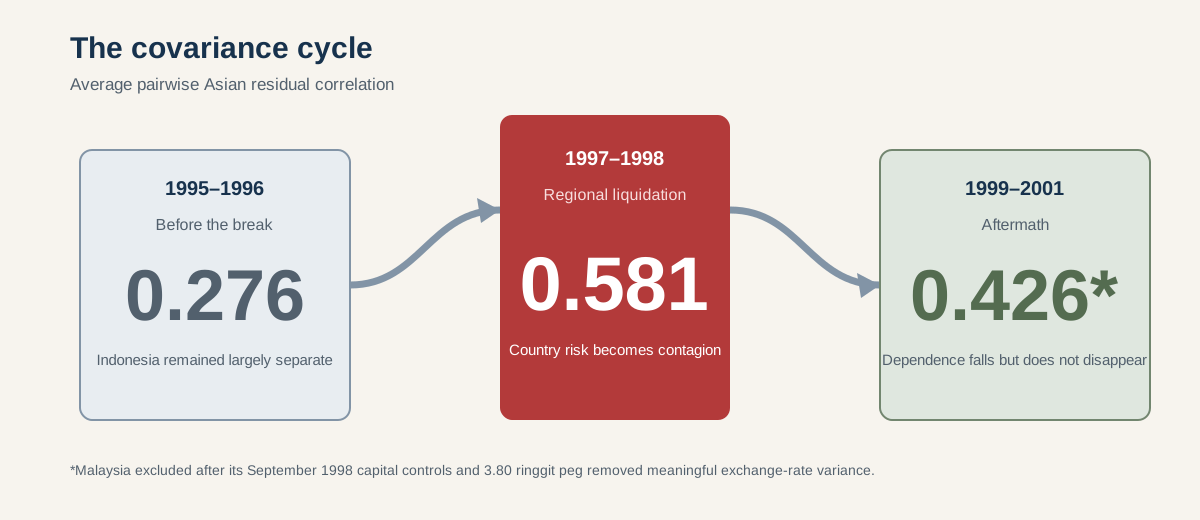
The post-crisis calculation initially produced a singular matrix. This was not a meaningless software error. In September 1998 Malaysia imposed capital controls and fixed the ringgit at 3.80 per dollar. With almost no exchange-rate variance, Malaysia could no longer enter the floating-currency SUR system in the same way.
Removing Malaysia allowed the 1999–2001 system to estimate normally. Average absolute residual correlation fell to 0.181 across the broader seven-country system. Within Asia, Thailand–Indonesia remained elevated at 0.589, while Thailand–Korea fell to 0.372 and Korea–Indonesia to 0.316.
Russia and Brazil: the second wave
By 1998 the crisis was no longer only Asian. Russia combined weak tax collection, short-maturity domestic government debt, political uncertainty and dependence on commodity revenue. Falling oil prices and the Asian slowdown made refinancing more difficult. The August default and devaluation damaged leveraged positions around the world and nearly brought down Long-Term Capital Management.
Brazil defended its exchange regime with high interest rates and reserves until January 1999, when the real was allowed to float. The sequence matters. Asian balance-sheet stress changed global risk appetite; Russia exposed the leverage embedded in supposedly diversified positions; Brazil then faced a market less willing to finance a defended exchange rate.
What SUR adds
Separate regressions can tell us how each currency relates to oil or Treasury yields. They cannot, by themselves, show how the unexplained shocks are connected. SUR makes the covariance matrix part of the model rather than an afterthought.
The method does not prove that one country caused another country's collapse. Nor does a residual correlation identify whether banks, hedge funds, trade exposure or political inference carried the shock. What it establishes is more modest and useful: the currencies became much less independent during the crisis, and the change was concentrated in the Asian system.
The national-currency lesson
The country essays in this series examine how national institutions shape money. This episode shows the limit of treating those institutions in isolation. Mexico's Tesobonos, Thailand's baht defense, Korea's bank funding, Indonesia's corporate dollar debt, Malaysia's controls, Russia's domestic debt and India's gradual capital-account opening were different arrangements. Global investors connected them through their own balance sheets.
A government can control the exchange rate for a time. It can regulate capital, borrow reserves, raise interest rates or guarantee banks. Each choice redistributes the adjustment. None abolishes it. When many countries have promised stability while depending on the same short-term foreign funding, one broken promise can change the price of every other promise.
The 1990s crisis began as a sequence of national currency problems. It became contagion when investors stopped pricing countries individually and began liquidating a region.
← Return to Examining National Currency
Data and further reading
- RainbowStats replication script and complete SUR output.
- Exchange-rate data: Federal Reserve Bank of St. Louis FRED series EXMXUS, EXBZUS, EXTHUS, DEXMAUS, EXKOUS, CCUSMA02IDM618N, CCUSMA02RUM618N and EXINUS.
- Global controls: FRED series GS10 and DCOILWTICO.
- International Monetary Fund, “The Asian Crisis: Causes and Cures.”
- International Monetary Fund retrospective on recovery from the Asian crisis.
- Federal Reserve History, “Mexican Peso Crisis.”
- Banco de México historical Tesobonos data.