The United States emerged from the Second World War with something close to an impossible advantage. Its industrial base was intact and vastly enlarged. Its principal competitors had been physically destroyed or financially exhausted. It held much of the world's monetary gold, produced goods the rest of the world desperately needed and possessed the military power to design a new international order.
American policymakers also understood that power came with a choice. The country could devote resources to military strength—guns. It could raise civilian living standards and build the institutions of a mass democracy—butter, broadly understood to include education, health, housing, infrastructure and social insurance. And it could preserve monetary and financial stability: a dependable dollar, a functioning Treasury market and a banking system able to finance both public and private ambition.
Each objective was defensible. A liberal system of international trade could not survive if authoritarian powers were free to destroy it. Social programs were not frivolous consumption; much of the American middle class was built through public investment, labor institutions and access to education, housing and health care. Financial stability was not simply a favor to Wall Street; without payments, credit and a market for federal debt, neither defense nor social investment could be sustained.
The conflict arose because America repeatedly behaved as though all three objectives could expand without limit and without an explicit distributional choice. When the arithmetic became uncomfortable, the country often used the dollar, the banking system and the Federal Reserve to postpone the reckoning. The result was not always immediate consumer-price inflation. Sometimes the pressure appeared in gold outflows, exchange rates, asset prices, leverage, public debt or the cost of housing. But adjustment was never abolished. It was moved across time and across groups.
| Objective | Public purpose | Constraint when overextended | Where adjustment appears |
|---|---|---|---|
| Guns | Deterrence, alliances and defense of an open international order | Uses taxes, borrowing, capital, engineering talent and productive capacity | Debt, taxes, inflation pressure or displaced civilian investment |
| Butter | Living standards, health, education, infrastructure and social insurance | Must be financed and designed to build durable capacity | Taxes, borrowing, inflation or future benefit reductions |
| Stability | A dependable dollar, functioning credit and prevention of destructive financial collapse | Backstops can protect asset values, encourage leverage and defer loss recognition | Asset-price inflation, public exposure, inequality or later tightening |
The charts organize the chronology; they do not claim that every event marker caused every movement in a series. Several historical series end before modern data begin, so the evidence is divided into monetary regimes. The essay distinguishes association from proof and distinguishes investment from consumption, whether the spending is civilian or military.
1945: victory created an economic problem
War had transformed the United States into the arsenal of democracy. Industrial production surged as factories were reorganized around aircraft, ships, vehicles, munitions and the immense logistical requirements of a global conflict. Washington did not merely purchase output. It directed materials, guaranteed demand, controlled prices, rationed consumption and helped mobilize labor and science on a scale never before attempted.
Victory ended the purpose for which much of that capacity had been created. Contracts disappeared faster than machinery, workers and communities could be reassigned. A decline in industrial production after the war therefore did not simply mean American decay. It reflected reconversion: the difficult movement from military output, much of which had been destroyed in use, toward homes, automobiles, appliances and the civilian capital stock.
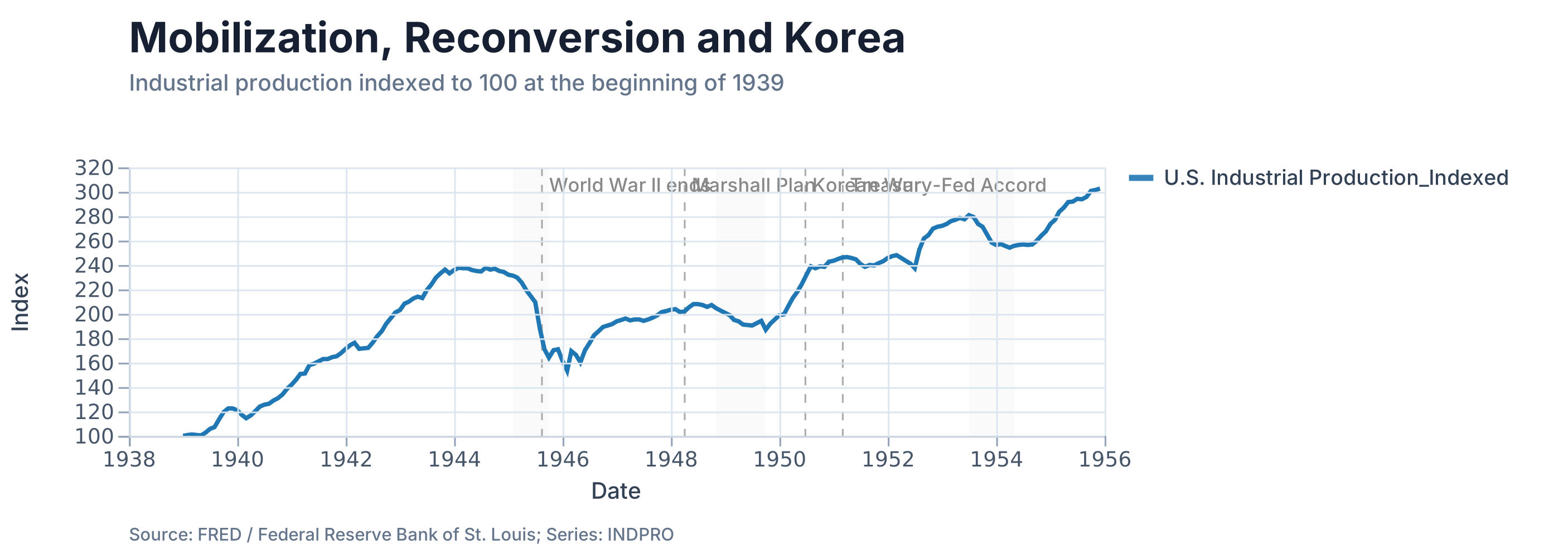
There was also a foreign counterpart to the domestic conversion problem. Europe needed food, fuel, machinery and reconstruction. The United States needed peaceful, solvent trading partners. The Marshall Plan, enacted in 1948, was at once humanitarian policy, Cold War strategy and demand policy. The State Department's historical account notes that the program helped revive European industrialization while creating markets for American goods. That is an important example of “butter” as investment rather than mere consumption: rebuilding foreign productive capacity strengthened a liberal order in which American production could find customers.
This is the first appearance of the three-way choice. America used economic assistance to secure a geopolitical result. It did not rely exclusively on weapons. The policy helped potential competitors become productive again, but that was not a mistake. A liberal world based on permanently impoverished allies would have been neither liberal nor stable.
The dollar system began from strength
The monetary architecture had been designed before the war ended. At Bretton Woods in 1944, forty-four nations agreed to a system of fixed but adjustable exchange rates. Participating currencies were tied to the dollar, and the dollar was convertible into gold for foreign monetary authorities at $35 an ounce. The International Monetary Fund would assist countries facing temporary balance-of-payments pressure, while the institution that became the World Bank would support reconstruction and development.
The system was credible because the United States began with productive dominance, a trade surplus and an extraordinary gold position. The dollar was not declared supreme by incantation; it was supported by the capacity to deliver goods and gold. That foundation is visible in the RainbowStats chart of Federal Reserve Bank gold reserves.
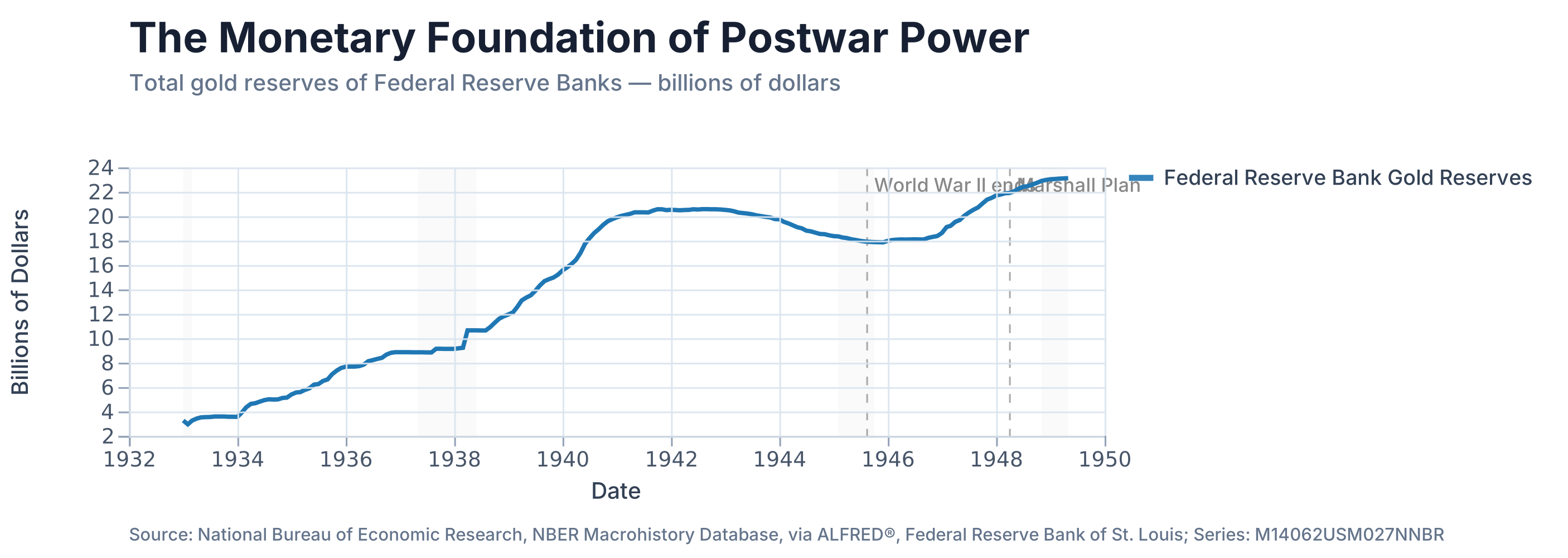
Bretton Woods nevertheless contained a structural tension. A growing world economy required a growing supply of reserves and therefore a growing supply of dollars outside the United States. But the more dollar claims foreigners accumulated, the harder it became to believe that every official holder could convert at the promised gold price. The system asked the United States to provide international liquidity while maintaining confidence that the supply of liquidity would remain limited.
That contradiction did not make collapse immediate. It made discipline necessary. The United States had to balance domestic employment and fiscal demands against an external promise. As long as its productive and financial position was overwhelming, the tension remained manageable. As allies recovered, military commitments expanded and domestic claims accumulated, the promise became harder to keep.
War finance and the first fight over stability
In April 1942 the Federal Reserve formally committed to a low rate on Treasury bills and implicitly capped long-term Treasury bond yields. Cheap and reliable finance was part of the war effort. To maintain the peg, however, the Fed had to buy securities whenever private investors refused the official price. It could control the interest rate or the size of its balance sheet, but not both.
The policy continued after victory because President Harry Truman and Treasury Secretary John Snyder wanted to protect the market value of war bonds and keep government financing inexpensive. Inflation, not depression, became the immediate postwar danger. The Korean War then added another military claim on production and finance. By early 1951 the conflict between supporting Treasury prices and controlling money creation could no longer be concealed.
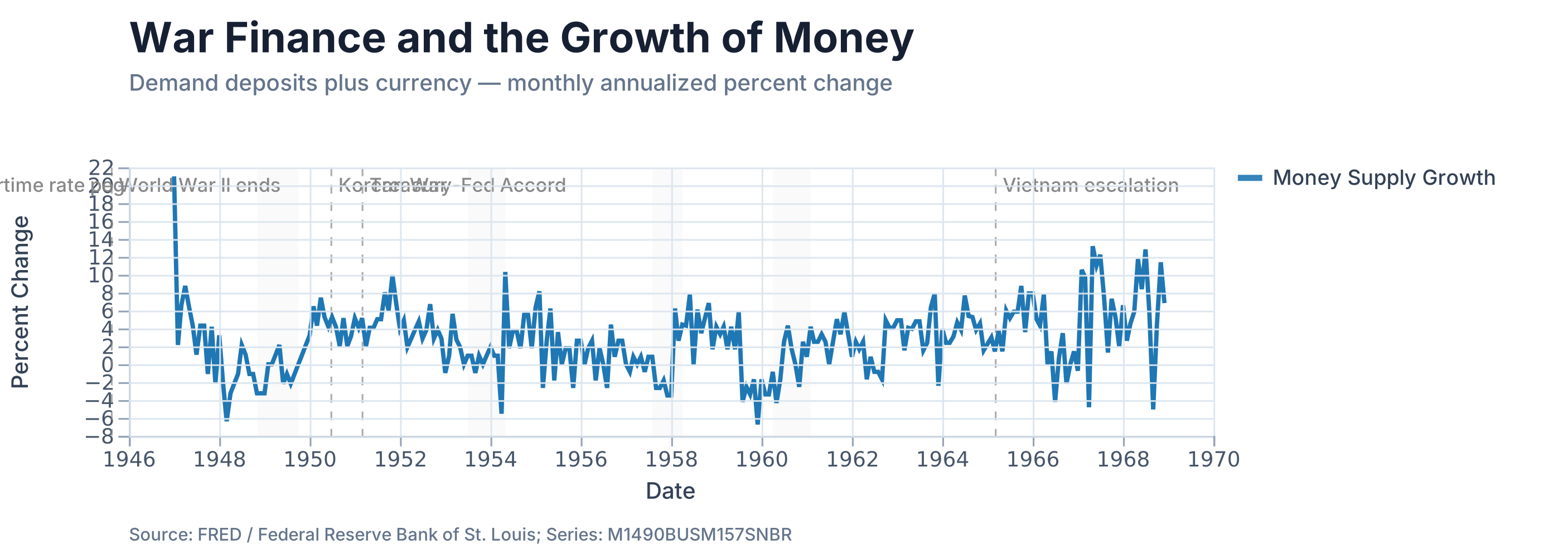
The Treasury–Federal Reserve Accord of March 1951 separated debt management from monetary policy and allowed market interest rates to rise. This was not a technical footnote. It was an early admission that the government could not simultaneously dictate the price of its debt, finance new military commitments and promise price stability without limit. The Accord established a boundary between fiscal power and the central bank, though later presidents and Fed chairs would repeatedly test it.
Eisenhower: the permanent mobilization
Dwight Eisenhower understood the need for military power better than almost anyone who has occupied the White House. He also understood its institutional appetite. When he left office in January 1961, he did not argue that America should disarm. He said the arms must be mighty enough to deter attack. His warning concerned what happened when a permanent military establishment, a permanent arms industry, federal research money and political influence fused into a self-sustaining system.
The phrase “military-industrial complex” has become so familiar that its economic content is easy to lose. Eisenhower was describing a change in the American allocation mechanism. Before the Second World War, civilian factories could be converted in an emergency. Under the Cold War, the nation maintained a specialized defense sector in peacetime. Engineers, capital, scientific talent and public borrowing were committed before any particular crisis arrived.
Eisenhower's subject was balance: between security and liberty, public and private claims, present action and the welfare of future generations. The military establishment was necessary. Its permanence made democratic scrutiny more necessary, not less.
Defense spending can generate technology, skilled employment and genuine public security. Radar, aviation, computing, satellites and the early internet demonstrate that military research can produce civilian spillovers. But a missile destroyed in use is not a bridge, a school or a machine tool. Military consumption and civilian investment cannot be treated as economically interchangeable merely because both raise measured GDP.
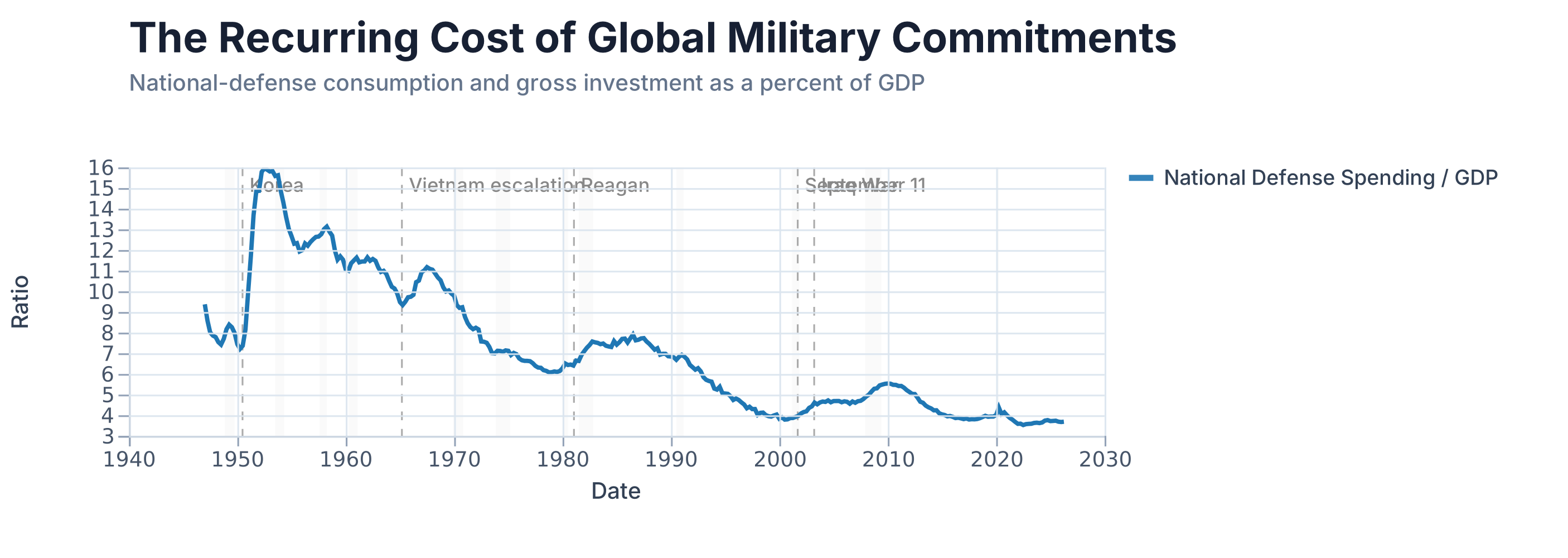
Eisenhower's restraint did not end the system. It named it. His successors would inherit an international order that depended on American power, domestic citizens who expected the fruits of prosperity and a financial structure expected to make the two compatible.
Kennedy and Johnson: guns and butter together
John Kennedy entered office promising vigor abroad and progress at home. Lyndon Johnson transformed the domestic side of that promise into the Great Society: Medicare, Medicaid, federal education support, civil-rights enforcement, urban programs and a broader attack on poverty. These were not simply giveaways. Health, education and equal access are components of productive capacity and democratic legitimacy.
At the same time, Vietnam escalated. Johnson resisted an explicit choice between war and domestic reform. Tax increases came late, and the combined pressure of military procurement and civilian demand met an economy approaching capacity. Federal Reserve chairman William McChesney Martin faced the familiar conflict: tighten enough to defend the dollar and restrain prices, or accommodate an elected government determined to pursue both foreign and domestic objectives.
The phrase “guns and butter” captured the fiscal argument, but it omitted the third point of the triangle. Bretton Woods required confidence in the dollar. As American inflation rose and the country supplied dollars abroad, foreign official holders had increasing reason to ask whether the United States could honor convertibility at $35 an ounce. The stability promise was becoming an additional claim on the same underlying productive base.
This does not mean the Great Society “caused” the Great Inflation, nor that social investment should have been abandoned. Vietnam, monetary accommodation, the external dollar constraint, energy shocks, wage and price dynamics and mistaken beliefs about a permanent inflation-unemployment tradeoff all mattered. The lesson is narrower and more useful: necessary programs still require taxes, resources or an explicit reallocation. Refusing to choose does not make the cost disappear.
Nixon and Burns: control the symptom
Richard Nixon appointed Arthur Burns as Federal Reserve chairman in 1970. Burns was a distinguished economist and an old adviser, but the relationship demonstrated how central-bank independence can erode under political pressure. The administration wanted expansion before the 1972 election. Inflation was treated as the product of unions, corporations, food, oil and special factors—almost anything except a monetary and fiscal regime trying to satisfy incompatible promises.
On August 15, 1971, Nixon suspended the conversion of official foreign dollar holdings into gold and announced a ninety-day freeze on wages and prices. Closing the gold window acknowledged that the external promise could not be honored on its existing terms. Controls attempted to suppress the visible expression of inflation while the underlying pressures remained. The Smithsonian Agreement briefly tried to preserve adjusted exchange-rate parities, but by 1973 the major currencies had moved toward generalized floating.
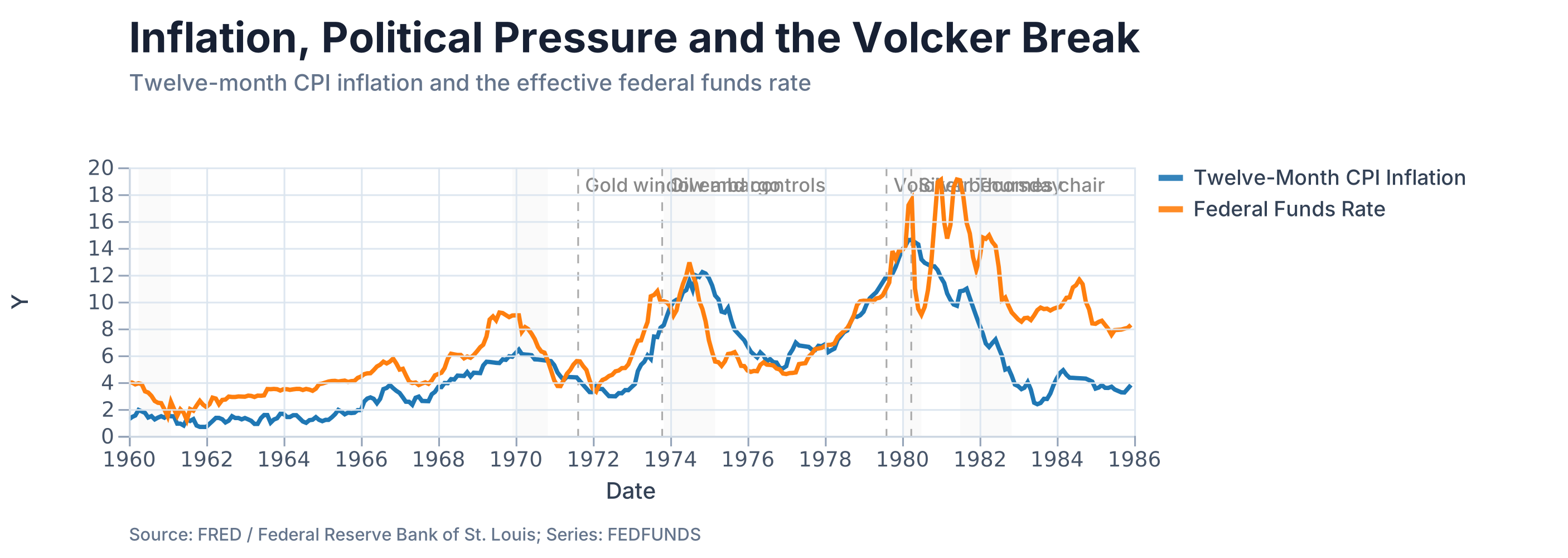
The oil embargo of 1973 and the Iranian disruption later in the decade were real supply shocks. Monetary policy could not produce petroleum. But a monetary regime can either accommodate a one-time increase in relative prices or allow it to become a continuing increase in the general price level. Under Burns, policy was too slow and too politically constrained to anchor expectations. Official controls made the measured problem look better temporarily and made the eventual adjustment more disruptive.
Once the dollar floated, the United States gained freedom from the gold constraint. It did not gain freedom from scarcity. Pressure could now appear through inflation, currency depreciation, higher interest rates and asset prices rather than through the loss of a fixed quantity of gold. The form of adjustment changed; the requirement for adjustment did not.
Carter and Volcker: stability restored through labor
Jimmy Carter inherited inflation, oil vulnerability and weakening public confidence. He appointed Paul Volcker in August 1979 after another sharp acceleration in prices. Volcker concluded that small rate adjustments and gradual persuasion would not restore credibility. In October the Fed changed its operating emphasis toward control of bank reserves and monetary aggregates, accepting much greater volatility in the federal funds rate.
The distinction matters. Under the traditional scarce-reserves system, banks needed reserve balances to settle payments and meet requirements. By altering the quantity of reserves supplied through open-market operations, the Fed influenced the marginal price of those reserves—the federal funds rate—and the capacity of the banking system to expand deposits and credit. Volcker used that mechanism aggressively. Rates rose to extraordinary levels, two recessions followed and unemployment exceeded 10 percent.
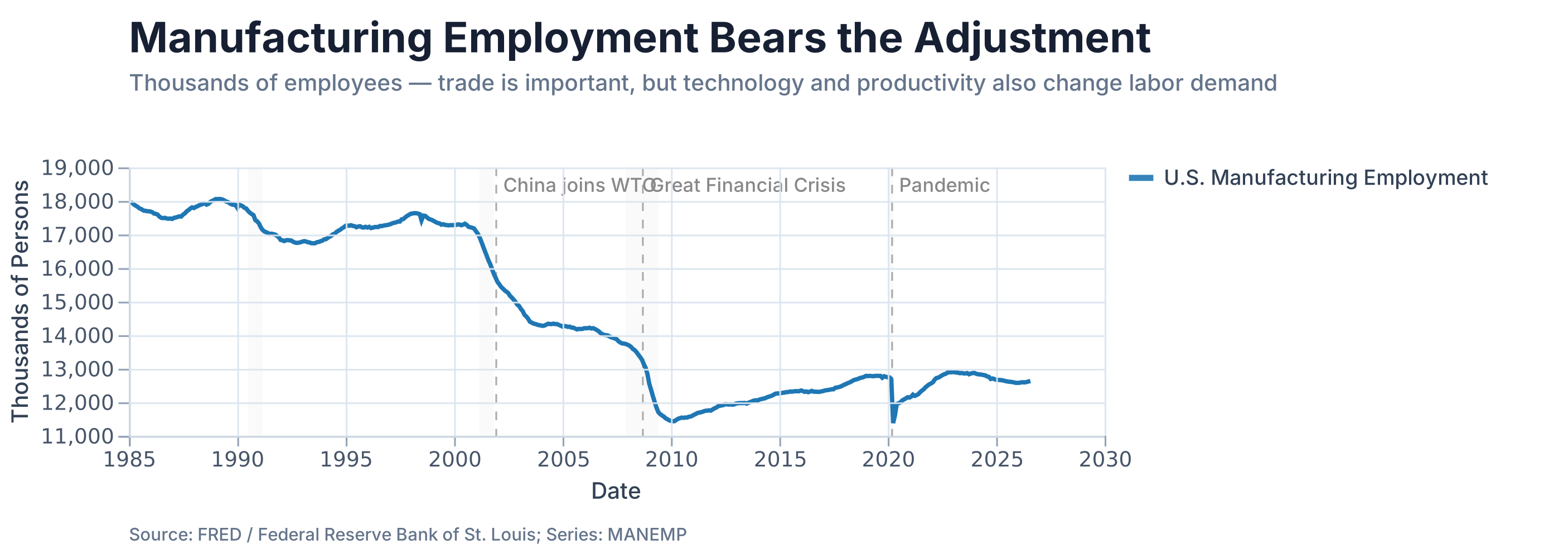
The policy broke inflation. It also broke firms, farms, construction projects and balance sheets that could not survive the cost of money. Manufacturing regions already exposed to foreign competition were hit particularly hard. Stability returned, but it was not costless and its costs were not evenly distributed. Owners of long-duration financial assets eventually benefited enormously from the subsequent decline in inflation and interest rates. Workers who lost jobs, bargaining power or communities could not mark those losses back to market when recovery arrived.
This is not an argument that Volcker should have allowed inflation to continue. Chronic inflation is itself regressive and destructive. Wages, savings and contracts cannot work well when the measuring unit is unstable. The point is that stabilization always has an incidence. The decision to postpone discipline during the Burns years increased the severity of the discipline later imposed under Carter and Volcker.
Reagan: disinflation, defense and debt
Ronald Reagan took office while the Volcker shock was still unfolding. His administration combined tax cuts, deregulation and a large defense buildup. Inflation fell, growth resumed and the dollar strengthened. The policy mix also produced large fiscal deficits and intense pressure on interest-sensitive industries. A strong dollar made imports cheaper and helped restrain inflation, but it placed additional pressure on American manufacturers and exporters.
Here again, categories matter. Reagan did not personally create every change associated with the 1980s. Volcker's monetary restraint began under Carter. Technological change and the recovery of Europe and Japan were independent forces. Yet the new regime did reinforce a particular distribution: price stability and financial returns gained priority, organized labor weakened, deregulation broadened the scope for finance and public debt absorbed the gap between tax policy, defense policy and other commitments.
The savings-and-loan crisis revealed how monetary stabilization could expose fragility accumulated under an earlier rate structure. Thrifts funded long-term, fixed-rate mortgages with shorter-term deposits. When market rates surged, their asset values collapsed and their funding costs rose. Regulators lacked the resources to close every insolvent institution. Forbearance kept “zombie” thrifts operating, deregulation gave some room to gamble for recovery and expanded deposit insurance helped them attract funds. The eventual Resolution Trust Corporation closed 747 institutions, with taxpayer costs estimated as high as $124 billion.
The lesson was not that regulation always succeeds or that rescue is always wrong. It was that delay can turn a manageable loss into a public obligation. Financial stability often means deciding which claims must be honored to protect the network. Once the state protects insured deposits and the payments system, private risk taking can create public exposure long before Congress formally appropriates money.
Greenspan: liquidity becomes a promise
Alan Greenspan became Fed chairman in August 1987. Two months later, on Black Monday, the Dow Jones Industrial Average fell 22.6 percent. The Federal Reserve immediately announced its readiness to provide liquidity and encouraged banks to continue lending to securities firms. The intervention was successful: a market crash did not become a banking collapse or a depression.
Success, however, changes expectations. Investors learned that when falling asset prices threatened market plumbing, the central bank would distinguish between the price of an asset and the stability of the system surrounding it. The Fed did not promise to make every investor whole. It promised liquidity to prevent forced sales, payment failures and credit contraction from feeding on one another. That distinction is economically valid but politically difficult, because stabilization of the network often stabilizes the value of claims held disproportionately by the wealthy.
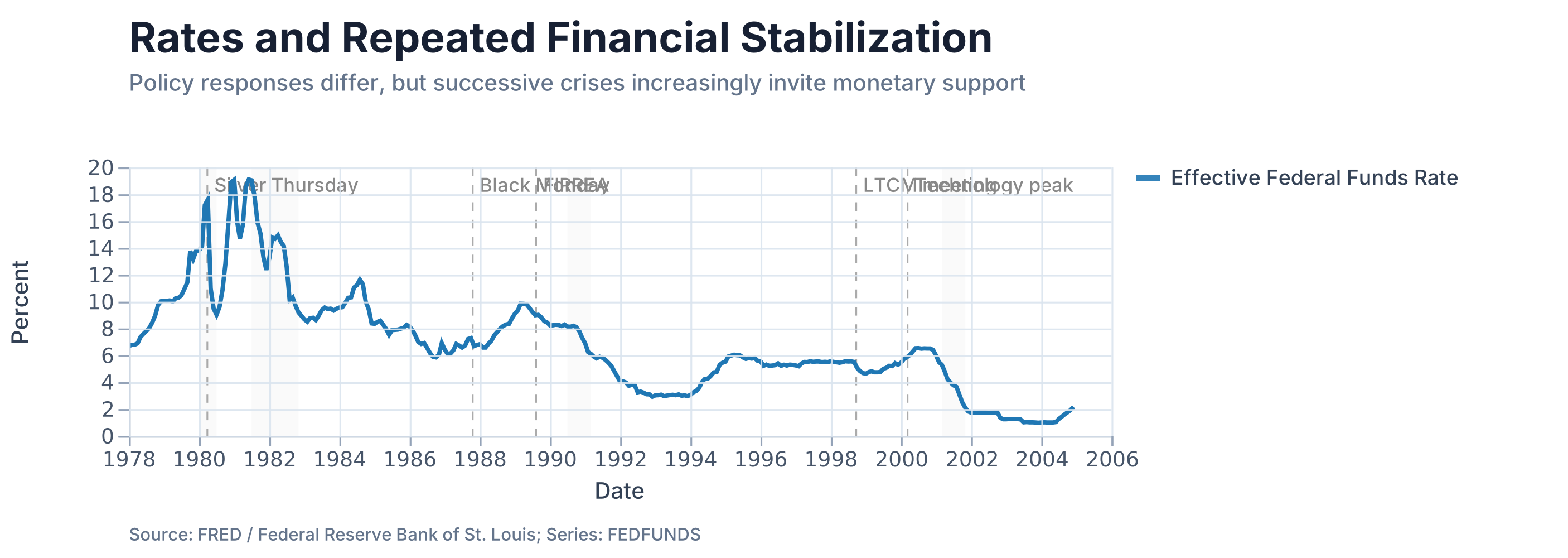
The pattern had a precursor in the Hunt brothers' silver collapse in March 1980. The Fed did not lend directly to the Hunts. Officials monitored and helped facilitate a private-bank credit arrangement because a disorderly default threatened brokers, banks and market functioning. The protected object was not the silver price or the speculators' fortune. It was the web of claims around them.
The same logic appeared in 1998 when the New York Fed convened the creditors of Long-Term Capital Management. The private consortium recapitalized the fund; the Fed did not write it a check. But official coordination reflected concern that a disorderly liquidation of a highly leveraged portfolio could destabilize markets. After the technology bubble collapsed, monetary policy eased again.
These actions helped produce the Great Moderation—a long period of relatively stable inflation and output. Better policy deserves some credit. So do favorable shocks, global supply chains and the entry of hundreds of millions of workers into world production. Yet calm macroeconomic averages concealed growing leverage, rising asset valuations and regional labor-market losses. Stability was real, but it was incomplete.
Globalization: a triumph with a domestic bill
The postwar order worked. Europe and Japan recovered. Developing countries industrialized. China became a manufacturing power and joined the World Trade Organization in December 2001. The success fulfilled a central purpose of the liberal system: other nations became richer through production and trade rather than conquest.
Americans often discuss that success as though it were a foreign plot. It was also a result of American strategy. The United States had spent decades promoting open markets, secure sea lanes, reconstruction, technology transfer and dollar liquidity. The objective could not logically be for every other country to remain poor while buying ever more American output.
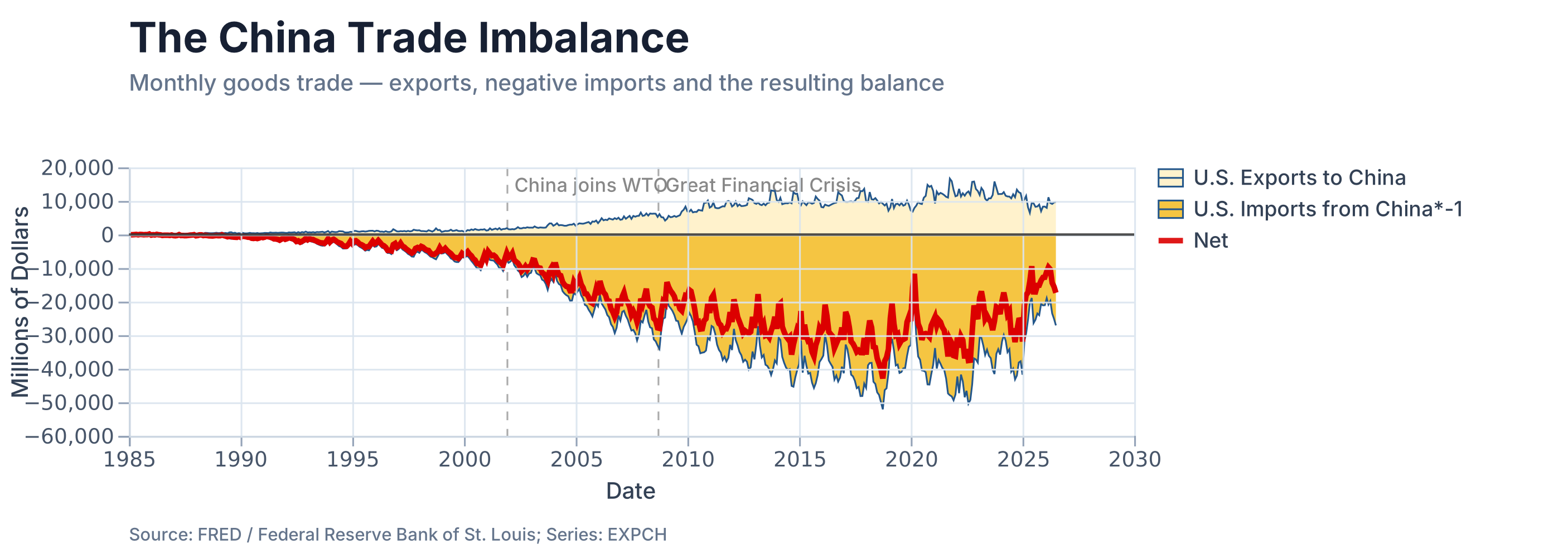
But aggregate gains do not compensate a laid-off worker automatically. Import competition, automation, productivity improvements, offshoring, a strong dollar and changes in corporate strategy all affected manufacturing employment. The exact share attributable to China is debated. The lived experience is not. A factory can disappear quickly; a worker, family or town cannot costlessly transform itself into a different industry in a different region.
In 2007 a fund manager asked me what I thought about China. My answer was simple: We want them to become richer—not for us to become poorer. That remains the right objective. Convergence is not defeat. It can occur because poorer countries grow faster while American productivity and real income continue to rise. The policy failure was not allowing foreigners to prosper. It was failing to invest seriously enough in the Americans required to absorb the adjustment.
A durable liberal trading system requires education, infrastructure, research, mobility, health care and social insurance. Those are not apologies for inefficiency. They are part of the capital structure of an open society. If capital can cross borders and reorganize production while labor bears the cost of place, family, retraining and lost seniority, political consent will eventually break.
Bernanke: saving the mechanism
Ben Bernanke became Fed chairman in 2006 after a long period in which inflation appeared contained and financial engineering appeared to distribute risk. Housing finance combined leverage, securitization, weak underwriting and confidence that national home prices would not fall together. When mortgage losses spread through opaque securities and short-term funding markets, the assumption failed.
The Federal Reserve created emergency facilities, cut rates and expanded its balance sheet. After short-term rates reached their effective lower bound, it purchased longer-term Treasury and mortgage-backed securities—quantitative easing—to reduce broader financing costs and support recovery. These actions helped prevent a depression-scale collapse of payments, credit and employment.
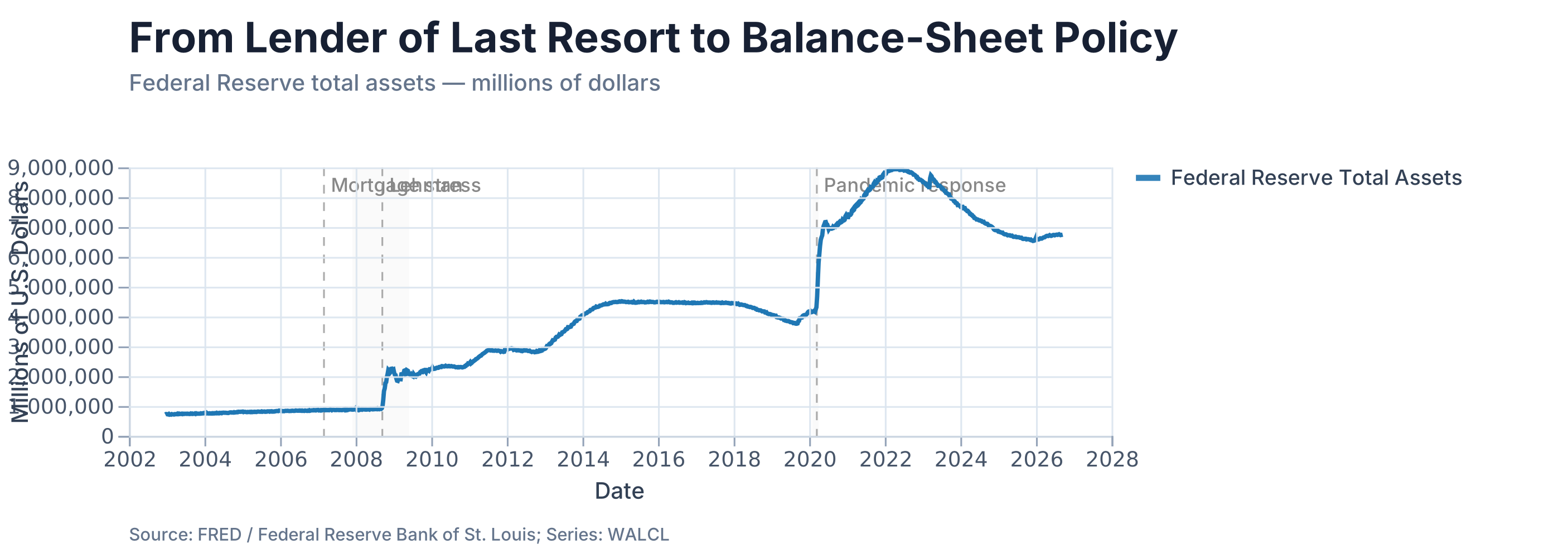
Saving the mechanism was not the same as restoring every participant. Banks could be recapitalized, securities markets restarted and mortgage rates reduced while millions of households remained underwater or lost homes and jobs. Asset prices recovered faster than many local labor markets. The intervention was necessary to avoid something worse, but necessity did not make its distribution invisible.
This is where the idea of financial insurance becomes precise. There was no blanket promise that capital could not lose. Lehman failed, equity was destroyed in institutions and many investors suffered. But once losses threatened the payments and credit system, the state placed its balance sheet behind the network. Capital owners were more likely than displaced workers to own claims whose prices benefited from restored liquidity and declining discount rates.
From scarce reserves to interest on reserves
The crisis also changed how the Federal Reserve controlled short-term interest rates. Before 2008, reserves were kept scarce. The Fed made relatively small adjustments to their supply, and the federal funds rate moved as banks borrowed and lent those balances. Large emergency loans and asset purchases flooded the banking system with reserves. In that environment, marginal changes in reserve quantity no longer controlled the funds rate in the old way.
Your memory of a change around 2011 points to the original statute. Congress authorized the Fed to pay interest on reserve balances in 2006, with implementation scheduled five years later, in 2011. The Emergency Economic Stabilization Act accelerated the date, and the Fed began paying interest on reserves on October 6, 2008. By 2010–2011, after quantitative easing and especially the second large-scale purchase program, reserve balances had become so abundant that the new mechanism was impossible to miss.
Under the abundant-reserves system, the Fed administered a rate paid on reserve balances. A bank ordinarily would not lend overnight at a rate far below what it could earn without credit risk at the Federal Reserve, so the administered rate helped anchor market rates. The floor was initially imperfect because important nonbank lenders could not receive interest on reserves; the later overnight reverse-repurchase facility broadened the set of institutions able to earn an administered return.
This is more than plumbing. Under the old approach, reserve scarcity transmitted policy through the marginal need for funds. Under the new approach, the Fed can maintain a much larger balance sheet and control rates partly by paying the banking system on reserve balances. Those payments are a monetary-policy tool, not a gratuitous subsidy. Still, they have fiscal and distributional consequences: higher rates increase the Fed's payments to eligible institutions and can reduce its remittances to the Treasury.
The progression from Volcker to Bernanke is therefore striking. Volcker tightened by controlling reserve growth in a scarce-reserves system. Bernanke responded to crisis by creating abundant reserves and then controlling their price. Both regimes sought command of short-term rates, but the operational meaning of “money” changed.
Debt absorbs the emergencies
The public balance sheet became the repository for repeated national claims: Reagan-era defense and tax choices, the savings-and-loan resolution, recession, the response to September 11, wars in Afghanistan and Iraq, the Great Financial Crisis and the pandemic. Debt is not inherently evidence of failure. A sovereign with productive capacity should borrow during war, depression, financial panic and public-health emergency. The error is to treat every emergency as exceptional while never rebuilding fiscal space afterward.
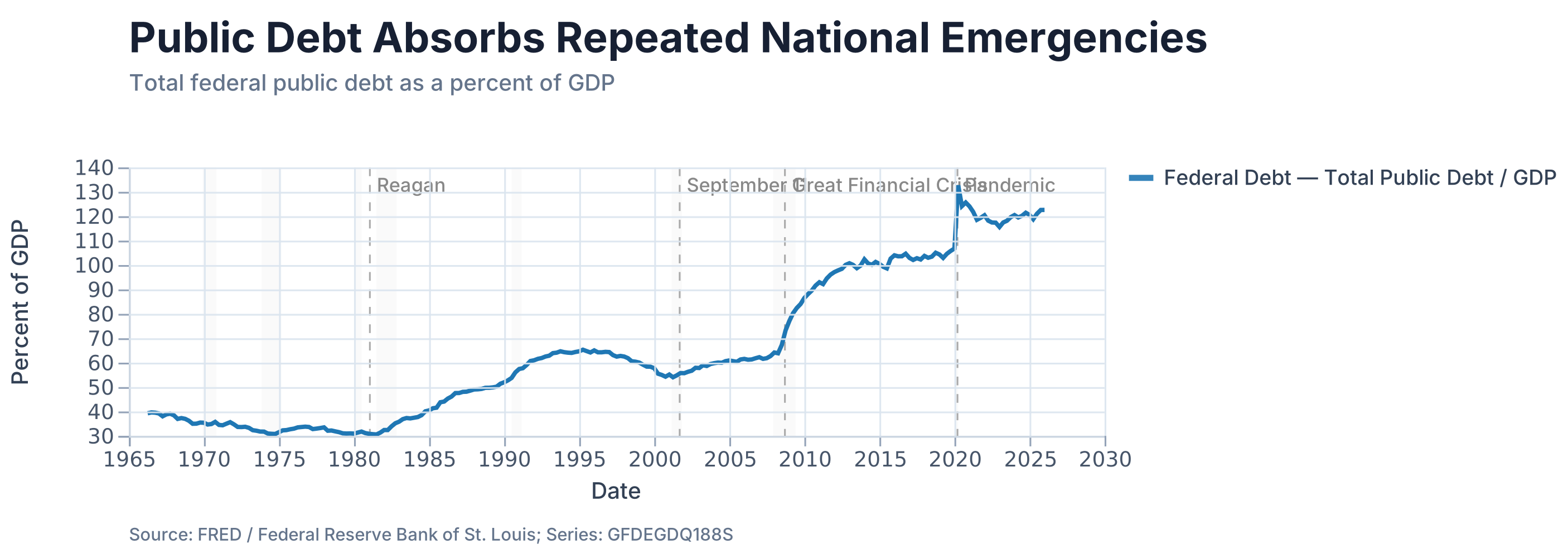
The dollar's reserve role has allowed the United States to borrow on terms most countries could not obtain. Global demand for safe dollar assets supported Treasury markets even as American trade deficits supplied dollars abroad. This privilege made the system resilient, but it also reduced the immediate price of postponement. Political leaders could cut taxes, maintain military commitments, protect major social programs and respond to crises without presenting the full bill at once.
Eventually the bill appears as taxes, inflation, interest expense, financial repression, reduced public investment or some combination. With debt near the scale of annual output, the global price of capital increasingly feeds directly into the federal budget. Stability itself becomes costly: higher rates needed to control inflation raise Treasury interest expense, while lower rates that ease financing can support leverage and asset valuations.
Productivity, compensation and the meaning of growth
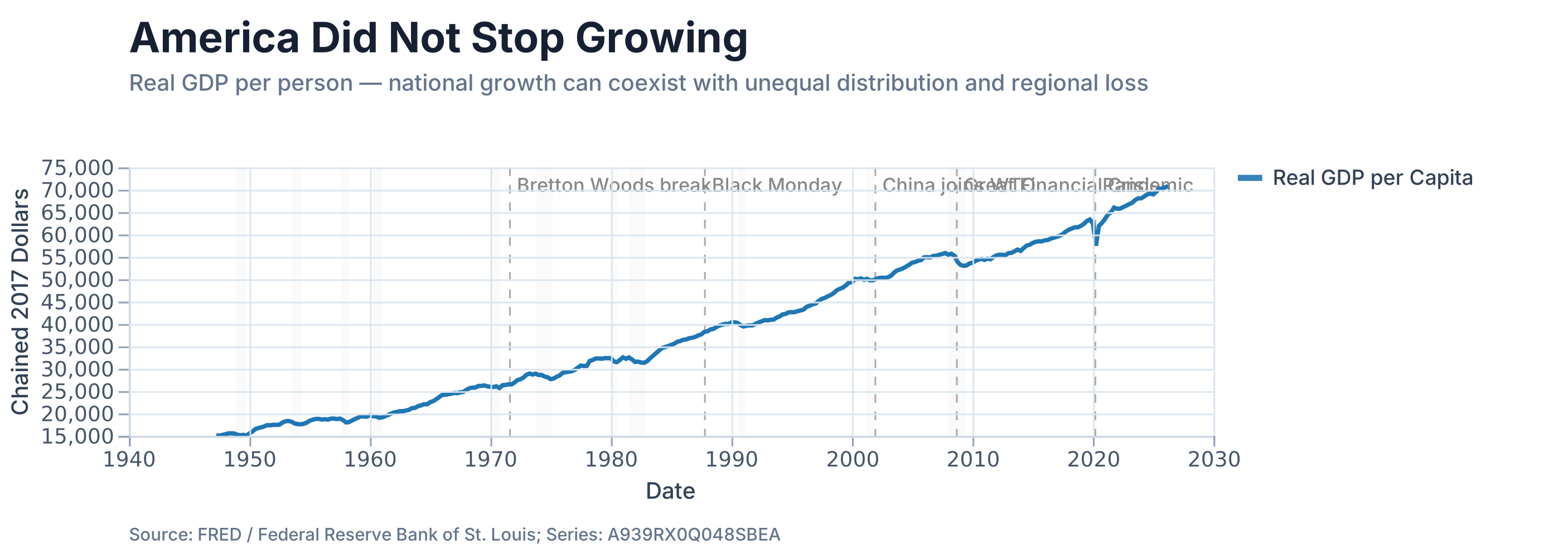
The United States did not stop growing. Real GDP per person rose enormously after 1947. Productivity continued to advance. A narrative of simple national collapse is empirically wrong and politically dangerous. It invites the fantasy that a strongman can restore a vanished golden age by punishing foreigners and overriding institutions.
Aggregate growth is not the same as broadly shared security. The RainbowStats comparison of labor productivity and real hourly compensation uses different concepts and coverage and therefore must be interpreted cautiously. It does not prove that every unit of productivity should appear mechanically in a particular wage measure. It does show that output capacity and worker compensation did not travel identically.
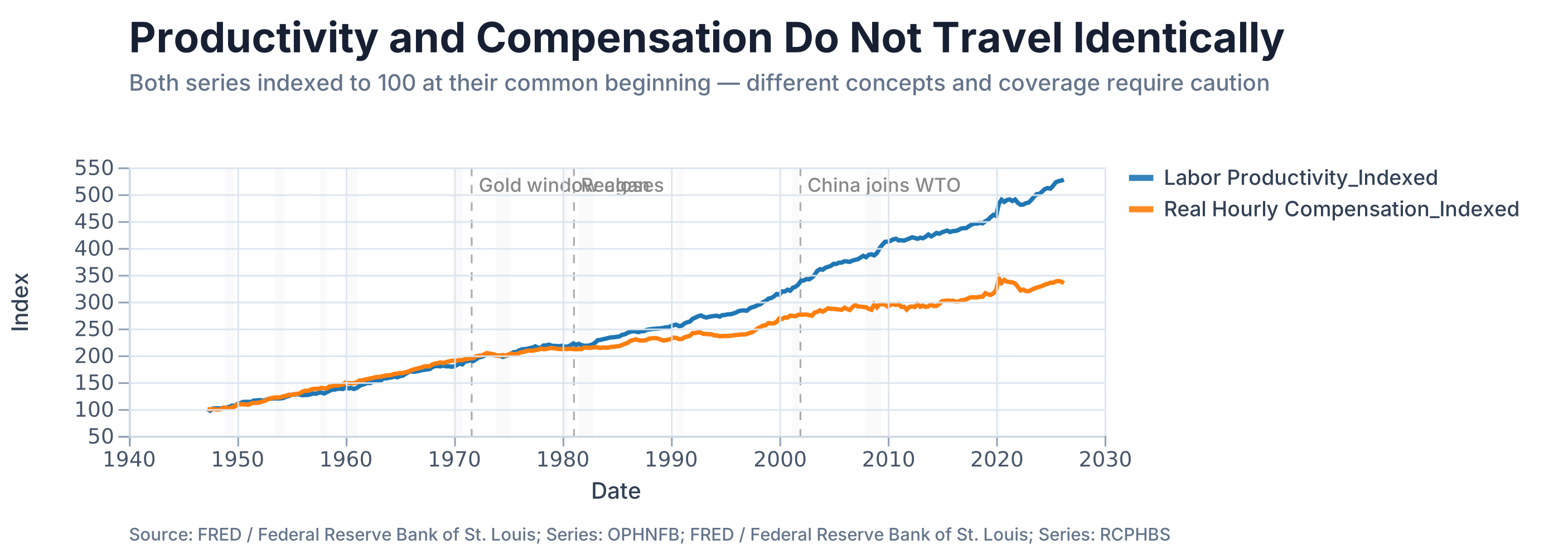
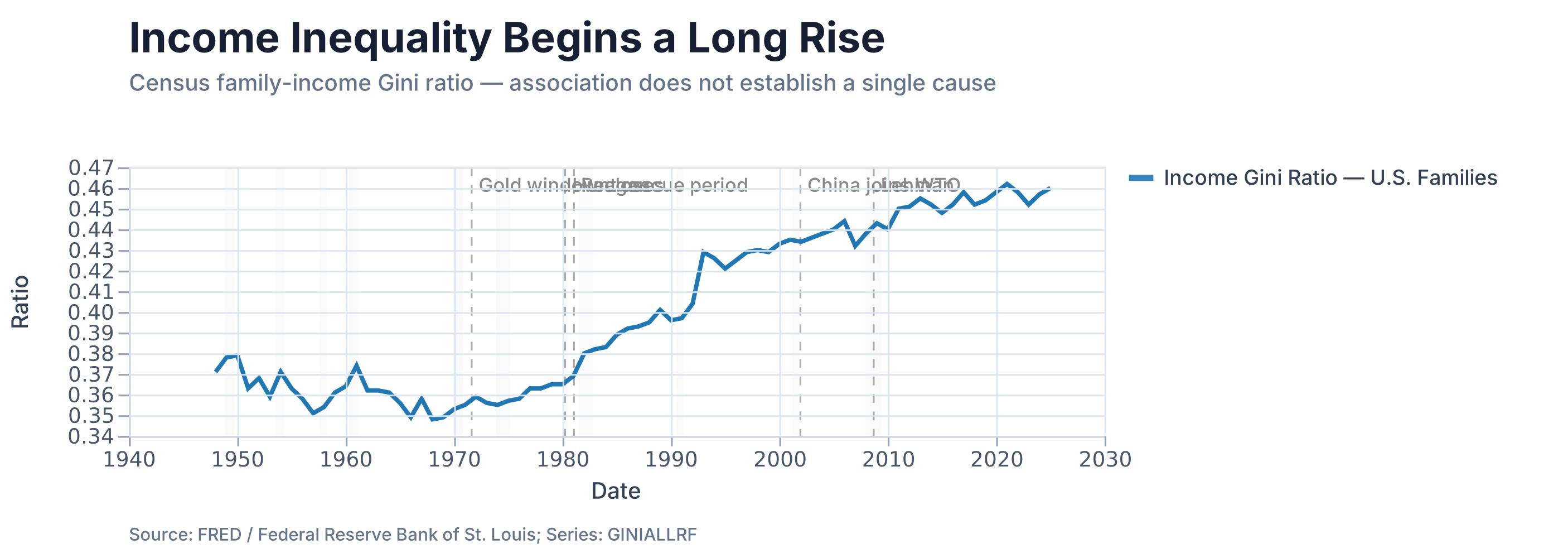
Income inequality rose after the 1970s. It would be careless to assign that rise to the end of Bretton Woods or to Federal Reserve policy alone. Technology, globalization, education, union decline, tax policy, deregulation, family structure, market concentration and asset ownership all contributed. But the monetary regime influences who benefits when credit is cheap, who owns assets that rise when discount rates fall and who loses bargaining power when stabilization operates through unemployment.
From Obama to the pandemic: recovery and reaction
Barack Obama inherited a collapsing economy and a financial system already dependent on extraordinary support. The administration and the Bernanke Fed stabilized the system and restored growth, but the recovery was uneven. Fiscal support receded while monetary policy carried much of the burden. That choice lowered rates and supported employment, yet it also relied heavily on financial channels. Homeowners and investors with assets participated in recovery sooner than many renters, workers and communities without them.
The anger that followed was not an econometric mistake. Many Americans saw institutions move with extraordinary speed when banks and markets were endangered, then move slowly when families faced foreclosure, addiction, disability, wage stagnation or regional decay. The comparison was sometimes unfair—central banks can create liquidity quickly but cannot rebuild a town or pass a health-care law. Politically, however, institutional capacity is judged by results, not jurisdiction charts.
Donald Trump's rise drew strength from real dislocation: manufacturing loss, insecure work, the status shock of global convergence and the belief that elite institutions had insured finance more effectively than labor. “Make America Great Again” offered restoration—a return to industrial dominance, social hierarchy and national freedom from external constraint. But the postwar moment cannot be recreated by tariffs, pressure on the central bank or demands that other nations accept permanent subordination.
The pandemic then produced the most rapid combination of fiscal and monetary support in modern American history. Under both Trump and Biden, the government replaced income, supported businesses and borrowed on an immense scale while the Federal Reserve expanded its balance sheet and stabilized credit markets. Much of this was defensible emergency policy. It also demonstrated again how the three claims converge: public protection, financial stability and national resilience were financed at once.
When constrained supply met extraordinary demand, inflation returned. The burden was again uneven. Households with fixed-rate mortgages and appreciating assets entered the episode differently from renters and workers buying necessities from current income. Later rate increases restrained demand but raised housing costs for new buyers and federal interest expense. There was no painless setting.
What money can—and cannot—do
Money and credit are not illusions. Liquidity can stop forced sales from becoming a destructive chain reaction. Lower rates can support employment and prevent debt deflation. Public borrowing can preserve demand during war, recession and emergency. A competent lender of last resort is one of civilization's great institutional achievements.
But money cannot manufacture skilled workers, repair a bridge, rebuild a community, produce semiconductors or decide how gains are distributed. It cannot substitute permanently for productive investment. When monetary support becomes the primary response to every structural problem, it can preserve nominal wealth and buy time while leaving the underlying adjustment unresolved.
Nor should every rise in asset prices be described as corruption. Lower discount rates increase the present value of future cash flows by arithmetic. Stabilizing demand improves expected profits. Preventing depression protects everyone, including workers. The distributional problem arises because ownership is unequal and because the policy tools that operate fastest run through markets. If society relies on those tools while neglecting labor institutions and public investment, the same intervention can be necessary in aggregate and unequal in incidence.
Power without myth
The United States still faces the three-way choice. It needs military capacity strong enough to deter authoritarian aggression and protect a system in which smaller nations have rights. It needs social investment sufficient to make open markets politically and economically sustainable. It needs price and financial stability so long contracts, savings, payments and public borrowing can function.
The answer is not to abolish one point of the triangle. It is to stop pretending the triangle has no budget constraint. Military consumption should not be mislabeled as investment merely because it creates jobs. Social investment should not be dismissed as “butter” when it expands human capacity. Financial stability should not become a euphemism for protecting every valuation or postponing recognition of loss.
A liberal world is not a world without power. It requires power restrained by law and directed toward a system in which other nations are allowed to prosper. The rise of Europe, Japan, China and developing nations need not require American poverty. But it does require America to invest in its own people rather than promise that monetary policy, protection or coercion can recreate the productive monopoly of 1945.
The grievances behind today's reactionary politics should not be dismissed. Workers did bear adjustment that mobile capital could often avoid. Communities did lose institutions and purpose. Finance was repeatedly stabilized through mechanisms ordinary citizens experienced as remote and unequal. Those facts deserve a democratic answer.
The authoritarian answer is restoration through enemies: foreigners, immigrants, internal dissenters, independent agencies or trading partners who refuse permanent submission. It mistakes dominance for prosperity and coercion for capacity. In attempting to recover an order that no longer exists, it risks destroying the liberal institutions that made American prosperity possible.
The democratic answer is harder. It accepts that defense is necessary, that social programs must be paid for and designed as investment where possible, and that financial losses must sometimes be recognized rather than indefinitely socialized. It uses fiscal policy openly, protects central-bank independence, invests in mobility and productive capacity, and makes the gains from growth broad enough that stability means more than the recovery of asset prices.
The United States remains extraordinarily wealthy, innovative and capable. Its danger is not that other nations rise. Its danger is mistaking the preservation of dominance for the preservation of prosperity—and mistaking postponed adjustment for a permanent solution.
Historical decision table
| Period | President and Fed leadership | Decision or shock | How the triangle was resolved |
|---|---|---|---|
| 1942–1951 | Roosevelt/Truman; Eccles and McCabe | Wartime Treasury-rate peg, reconversion and Korea | Cheap war finance initially dominated; the 1951 Accord restored a boundary between debt management and monetary policy. |
| 1953–1961 | Eisenhower; Martin | Permanent Cold War mobilization | Defense remained essential, but Eisenhower warned that a permanent armaments industry could capture resources and policy. |
| 1961–1969 | Kennedy/Johnson; Martin | Vietnam and Great Society expansion | Guns and social investment expanded together while the external dollar constraint weakened. |
| 1969–1978 | Nixon/Ford; Burns | Political accommodation, gold-window closure and wage-price controls | The gold promise was abandoned and the visible symptom of inflation was temporarily controlled rather than resolved. |
| 1977–1987 | Carter/Reagan; Miller and Volcker | Reserve targeting and the inflation break | Price stability was restored through high rates, recession and concentrated costs for labor, industry and leveraged balance sheets. |
| 1987–2006 | Reagan through George W. Bush; Greenspan | Black Monday, LTCM, globalization and the technology bust | Liquidity intervention increasingly protected market functioning, strengthening expectations of a central-bank backstop. |
| 2006–2014 | George W. Bush/Obama; Bernanke | Great Financial Crisis, quantitative easing and interest on reserves | The Fed saved the credit mechanism and moved from scarce-reserve control toward balance-sheet policy and administered rates. |
| 2020 onward | Trump/Biden; Powell | Pandemic fiscal and monetary intervention, followed by inflation | Emergency support protected incomes and markets together; later tightening again distributed the cost through rates and credit. |
Federal Reserve operating regimes
| Regime | Main operating mechanism | Central problem | Historical meaning |
|---|---|---|---|
| Wartime peg | Fed purchases maintained official Treasury yields | Financing war cheaply while containing money growth and inflation | Rate control forced the balance sheet and money supply to adjust. |
| Post-Accord scarce reserves | Open-market operations changed reserve scarcity and the federal funds rate | Balancing employment, prices and Treasury-market conditions | The 1951 Accord created modern monetary-policy independence. |
| Volcker reserve targeting | Greater emphasis on reserve and monetary-aggregate growth | Breaking entrenched inflation expectations | Interest-rate volatility and recession were accepted as the price of restoring credibility. |
| Greenspan rate targeting | Federal funds target adjusted through scarce-reserve operations | Maintaining low inflation while responding to market disruptions | Successful liquidity support encouraged belief in a financial backstop. |
| Bernanke balance-sheet policy | Emergency facilities, large-scale asset purchases and interest on reserves | Operating after reserves became abundant and short rates approached zero | The Fed began paying interest on reserves in October 2008; Congress had originally scheduled the authority for 2011. |
| Ample-reserves framework | Administered rates on reserve balances and overnight reverse repos | Controlling short rates with a large central-bank balance sheet | The marginal price of reserves increasingly replaced reserve scarcity as the policy anchor. |
Sources and replication
- Complete RainbowStats study and slideshow
- U.S. Department of State: Marshall Plan, 1948
- National Archives: Eisenhower's farewell address
- Federal Reserve History: The Treasury–Fed Accord
- Federal Reserve History: Creation of the Bretton Woods System
- Federal Reserve History: The Great Inflation
- Federal Reserve History: Arthur Burns, Paul Volcker, Alan Greenspan and Ben Bernanke
- Federal Reserve History: Stock Market Crash of 1987
- Federal Reserve History: Savings and Loan Crisis
- Federal Reserve History: The Great Recession and Its Aftermath
- Federal Reserve History: Interest on Reserves and the Federal Reserve's IORB FAQ
Principal data series
INDPRO industrial production; M14062USM027NNBR Federal Reserve Bank gold reserves; M1490BUSM157SNBR historical money growth; FDEFX defense consumption and investment; CPIAUCSL consumer prices; FEDFUNDS effective federal funds rate; GINIALLRF family-income Gini ratio; WALCL Federal Reserve assets; GFDEGDQ188S federal debt to GDP; IMPCH and EXPCH China goods trade; MANEMP manufacturing employment; OPHNFB labor productivity; RCPHBS real hourly compensation; and A939RX0Q048SBEA real GDP per capita.