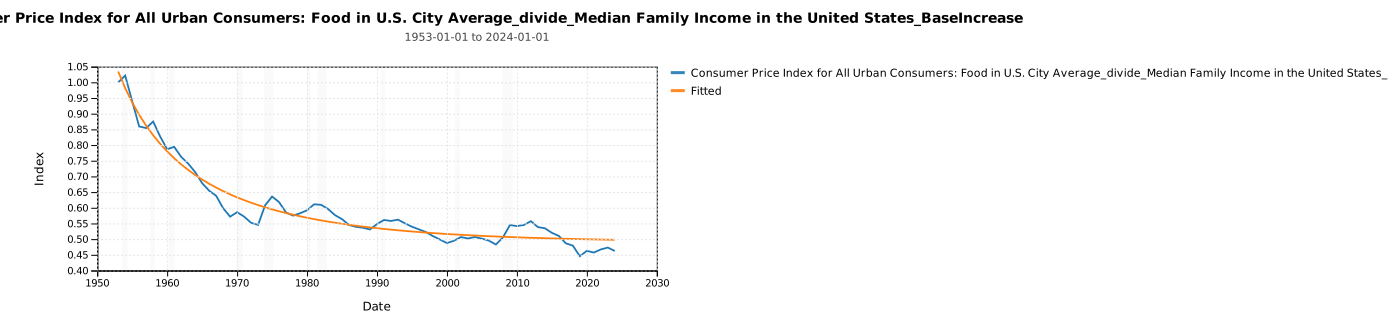
In a previous post, I looked at the cost of providing a basic meal for a family of four. Measured against household income, the cost of food prepared at home has shown a long decline. In dollar terms, feeding a family at home has become easier than it was several decades ago.
But households do not budget dollars alone. They also budget time.
A home-cooked meal may be cheaper than restaurant food, but the raw price of food is only part of the household decision. A meal at home also requires shopping, storage, preparation, cleanup, and planning. Those costs are not always visible in the grocery receipt, but they are real.
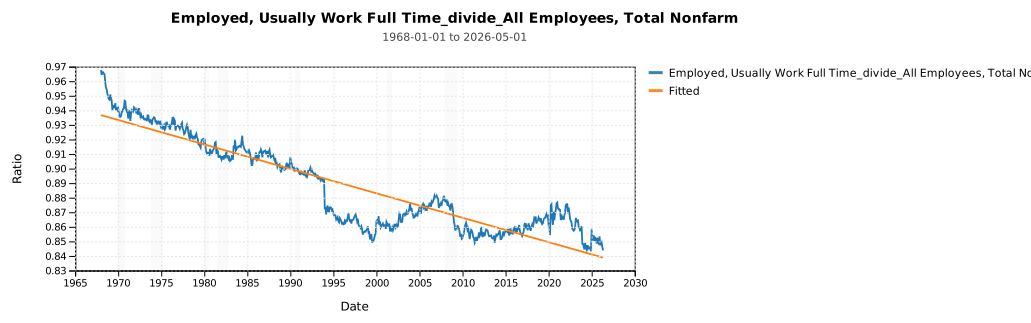
This matters because the structure of employment has changed. The share of workers usually employed full time has declined over the long run. That does not necessarily mean people have more leisure. It may mean less predictable schedules, more fragmented work, multiple jobs, or a greater need to economize on household time.
The central idea is simple: fast food does not only sell food. It sells time savings.
The chart below compares the share of workers usually employed full time with total nonfarm employment. The long-run decline is visible. While there are cyclical movements around recessions, the broader trend is downward.
At the same time, restaurant and food-service sales have risen as a share of GDP. This does not prove that weaker full-time employment causes more dining out, but the two series tell a consistent story. As employment becomes less standardized, households may substitute prepared food for household labor.
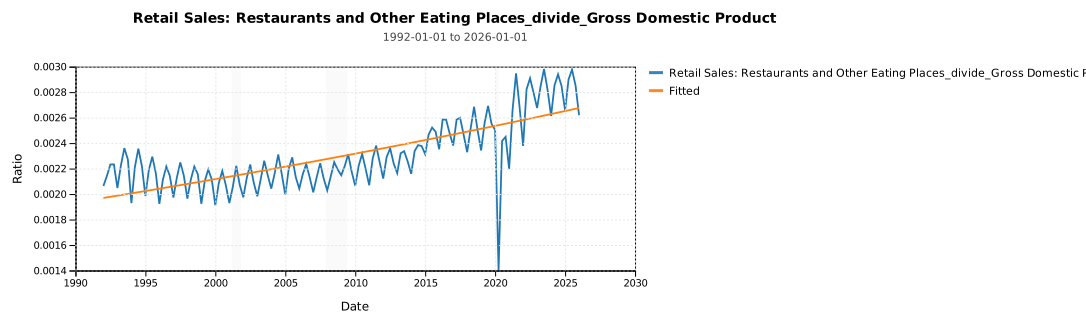
To test the relationship more formally, I ran a transfer-function model using the full-time employment share as the explanatory series and restaurant sales relative to GDP as the response. The model does not explain everything. The R-square is modest. But the lagged relationship is statistically visible.
slideshow(transfer_function(foodout, ratiofulltime))The strongest result appears at the first lag. A decline in the full-time employment share is associated with a later increase in restaurant and food-service spending relative to GDP. The second lag partially reverses the effect, suggesting that the relationship is not a simple one-way trend but a short-run adjustment in household behavior.
It is easy to look at restaurant spending and say that consumers should simply cook more at home. But that ignores the full household budget. Consumers, as a group, usually make sensible tradeoffs. A fast-food meal may cost more than the raw ingredients, but it also replaces shopping, preparation, cleanup, and planning.
When work schedules become less stable, or when full-time employment becomes less dominant, the value of saved time rises. In that setting, eating out is not necessarily wasteful. It may be an efficient household decision.
The data support a useful interpretation: the rise in restaurant and fast-food spending is not only a food-price story. It is also a time-budget story. Food prepared at home may be cheaper, but the cost of preparation has risen relative to the way many households now work and live.
That makes fast food and restaurant spending a window into something larger: how households adapt when income, time, and work routines change.